竭
Character Story & Explanation
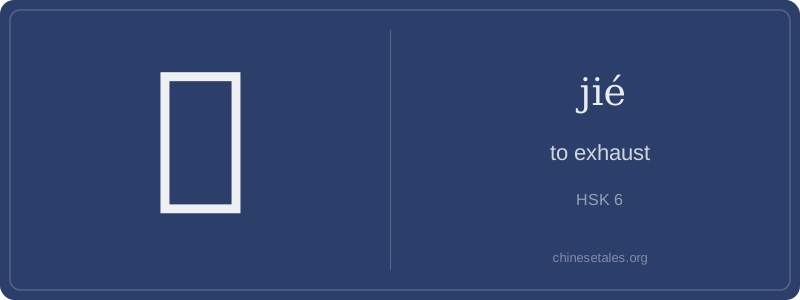
The earliest form of 竭 appears on Warring States bronze inscriptions as a complex ideograph: top half resembled 立 (standing upright), while the bottom was 又 (a hand) gripping something like a bundle of stalks or ropes — suggesting a person standing firm while *pulling until nothing remains*. Over centuries, the lower component simplified into 曷 (hé), a phonetic hint (though pronunciation shifted from hé to jié), and the whole character condensed into today’s 14-stroke form: 立 + 曷. Notice how the ‘standing’ radical anchors the idea of *deliberate, upright exertion* — not collapse, but steadfast depletion.
This visual logic deepened in classical texts: In the *Zuo Zhuan*, we read of generals who ‘竭其心力’ (jié qí xīn lì, 'exhausted their heart-and-strength') defending borders — the character evokes moral stamina, not mere fatigue. By the Tang dynasty, poets like Du Fu used 竭 to describe creative drought: ‘才尽’ (cái jìn) meant talent dried up, but ‘才竭’ (cái jié) implied a deeper, almost spiritual exhaustion of inspiration. The shape itself — upright, composed, yet internally drained — mirrors the Confucian ideal: dignity preserved even at the point of total depletion.
At its core, 竝 isn’t just ‘to exhaust’ — it’s the visceral feeling of hitting absolute zero: lungs burning, reserves gone, willpower fraying at the edges. The character carries a tone of noble desperation, often implying effort pushed to its ethical or physical limit (think soldiers defending a pass, doctors working through a pandemic night, or scholars poring over crumbling bamboo slips). Unlike generic verbs like 用完 (yòng wán, 'to use up'), 竭 implies *intentional, sustained, often admirable depletion* — you don’t ‘exhaust’ your coffee; you 竭 your strength for someone else.
Grammatically, 竭 is almost always transitive and formal. It rarely stands alone as a main verb in speech — instead, it shines in compound verbs (竭力, 竭尽) or passive/abstract constructions. You’ll see it in phrases like ‘竭尽所能’ (jié jìn suǒ néng, 'exhaust all one’s ability') or the literary passive ‘精力已被竭尽’ (jīng lì yǐ bèi jié jìn, 'one’s energy has already been exhausted'). Learners often mistakenly use it with concrete, countable nouns ('I exhausted three pens'), but 竭 resists that — it governs abstract capacities: strength, resources, effort, wisdom, loyalty.
Culturally, 竭 echoes Confucian ideals of self-sacrifice and unwavering duty — Mencius praised ministers who ‘竭忠以事君’ (jié zhōng yǐ shì jūn, 'exhaust their loyalty to serve the ruler'). A common pitfall? Overusing it in casual speech — saying ‘我竭了’ sounds like a Ming-dynasty general collapsing after battle, not someone tired after Zoom class. Reserve it for gravity, not groceries.