篷
Character Story & Explanation
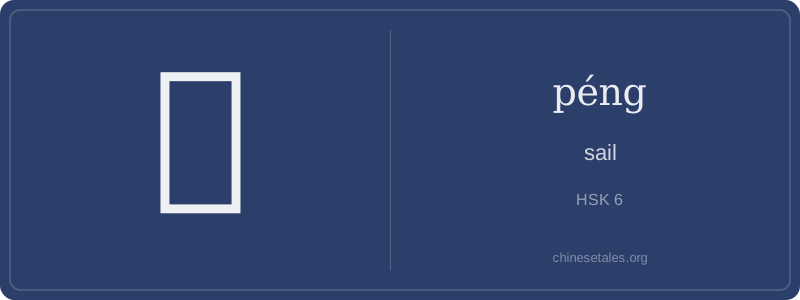
The earliest form of 篷 appears in Han dynasty clerical script — not oracle bone, since it’s a relatively late character — as a vivid composite: the top ⺮ (bamboo) radical hints at the flexible, interwoven framework, while the bottom 鹏 (péng, ‘roc’, the mythical giant bird) was borrowed phonetically but also evokes *soaring, expansive coverage*. Over centuries, the 鹏 component simplified: its complex bird shape (with wing, eye, and tail strokes) gradually condensed into the modern 蓬 — losing the bird’s head but keeping the ‘flourishing, spreading’ sense through the grass radical (艹) and the ‘fullness’ of 逢. The 16 strokes map this evolution: 6 for ⺮, then 10 for the streamlined phonetic-semantic blend below.
This character didn’t exist in Classical Chinese — it emerged during the Tang-Song transition, when maritime trade boomed and vernacular literature flourished. In Song dynasty texts like *Dream Pool Essays*, 篷 appears in descriptions of ‘wind-adjusting sail-covers’ on grain barges. Its visual logic is brilliant: bamboo (⺮) provides the resilient, bendable skeleton; the phonetic 蓬 (itself meaning ‘luxuriant growth’) suggests how the fabric billows, swells, and fills with wind — like lush grass catching the breeze. So 篷 isn’t just a thing; it’s a *verb made noun*: the action of swelling into shelter.
At first glance, 篷 (péng) feels like a quiet, sturdy character — and that’s exactly its vibe in Chinese: it doesn’t shout, but it shelters, covers, and supports. Its core meaning isn’t just ‘sail’ (as often simplified in dictionaries), but more precisely *a large, flexible, woven covering* — whether stretched over a boat (sail), a cart (canopy), or a festival stage (awning). Think of it as the ancient Chinese word for ‘fabric architecture’: functional, tensioned, and weather-defying.
Grammatically, 篷 is almost always a noun and rarely stands alone; it appears in compound nouns like 帐篷 (zhàng peng, tent) or 帆篷 (fān péng, sail — though this term is now literary/technical). Crucially, it’s never used as a verb (unlike English ‘to sail’), nor does it mean ‘tent’ by itself — saying *‘我搭篷’* without context sounds odd to native ears; you’d say *‘搭帐篷’*. Learners sometimes overgeneralize it to any kind of cover, but it implies *woven, pliable, structural fabric*, not plastic tarps or metal roofs.
Culturally, 篷 carries echoes of pre-modern mobility and craftsmanship: from river traders on the Yangtze adjusting their bamboo-reinforced sails, to Qing dynasty opera troupes raising canvas canopies in village squares. A common mistake? Confusing it with 逢 (féng, ‘to meet’) — same pronunciation but zero semantic link — or misreading its radical as mere decoration, when ⺮ (bamboo) signals its original material basis: early sails and awnings were literally woven from split bamboo strips and hemp cloth.