簸
Character Story & Explanation
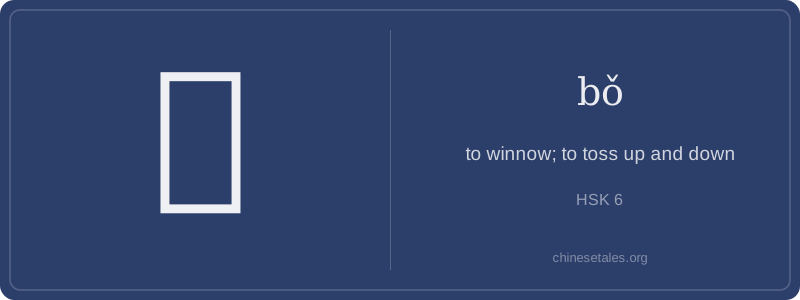
The earliest form of 簸 appears in bronze inscriptions as a compound pictograph: a bamboo basket (⺮) held aloft, with grains flying upward (represented by scattered dots or a simplified ‘upward arrow’ shape above), and beneath it, a hand (又) actively lifting. Over centuries, the ‘hand’ evolved into the right-hand component ‘皮’ (pí, ‘skin’), which was borrowed phonetically — not semantically — because its Old Chinese pronunciation *braʔ closely matched the word for winnowing. The bamboo radical ⺮ stayed firm, anchoring the meaning in the tool used: the woven bamboo winnowing tray.
By the Han dynasty, 簸 was firmly entrenched in agricultural texts and Confucian classics as both literal and metaphorical sifting. In the Rites of Zhou, officials ‘winnowed’ candidates for office — using 簸 as a powerful metaphor for rigorous selection. Its visual structure — tall, narrow, top-heavy with ‘grains’ rising — mirrors the actual motion: a swift upward toss, then letting gravity and wind do the rest. Even today, when writers describe a flag flapping violently in gales or rumors spreading chaotically, they choose 簸 over simpler verbs to imply that chaotic motion has a hidden logic — like wind revealing what’s light and hollow.
Think of 簸 (bǒ) as Chinese ‘sifting theater’ — like a farmer on stage tossing grain in the wind, not just moving it, but performing a precise separation ritual. It’s not generic ‘shaking’; it’s purposeful, rhythmic, aerodynamic winnowing — separating chaff from grain using air currents. That’s why you’ll rarely see it alone: it almost always appears in compounds (like 簸箕 or 簸扬) or in literary/idiomatic contexts describing deliberate, often laborious, sorting — physical or metaphorical.
Grammatically, 簸 is almost never used as a standalone verb in modern speech. You won’t say ‘I bǒ the rice’ — instead, it appears in fixed phrases or as part of verbs like 簸扬 (bò yáng, ‘to winnow’), or in vivid descriptive clauses: ‘风簸大旗’ (fēng bǒ dà qí — ‘the wind tosses the great banner’). Notice the poetic inversion: the subject (wind) does the ‘bǒ’, emphasizing force and motion, not human agency. Learners often mistakenly use it like 摇 (yáo, ‘to shake’) — but 簸 implies vertical, up-and-down flinging with intent to separate, not side-to-side rocking.
Culturally, 簸 evokes agrarian precision and classical restraint — no wasted motion. Mistake it for a casual synonym of 抖 (dǒu, ‘to shake off’) and you’ll sound oddly archaic or overly dramatic. It’s HSK 6 for good reason: its power lies in economy and imagery, not frequency. In idioms like ‘簸之扬之,糠秕在前’ (from the Book of Rites), it symbolizes moral discernment — sifting truth from falsehood, just as wind separates grain from husk.