筹
Character Story & Explanation
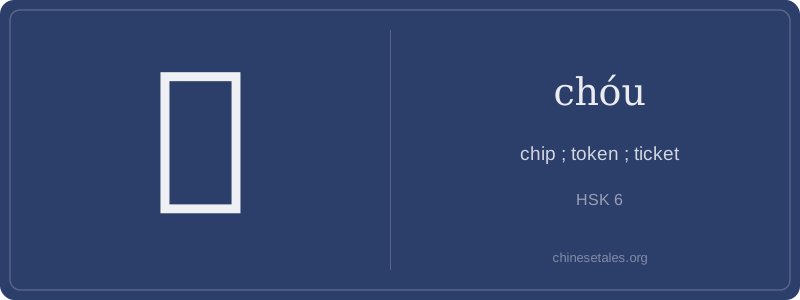
The earliest form of 筹 appears in Warring States bamboo slips—not as a pictograph, but as a clear ideograph: ⺮ (bamboo) + 寿 (shòu, originally depicting a ceremonial staff or extended life symbol, later simplified). The original bronze inscriptions show two bamboo stalks crossed over a phonetic component, emphasizing *measured, ritualized counting*. Over time, 寿 was streamlined into 壽 (then 寿), losing its ‘longevity’ connotation but retaining phonetic function—while the bamboo radical ⺮ stayed resolutely at the top, anchoring the character’s material origin.
By the Han dynasty, 筹 meant both literal counting rods and metaphorical ‘resources’: Sima Qian’s *Records of the Grand Historian* describes generals ‘counting 筹’ before battle—a moment of calm calculation amid chaos. In Tang poetry, 筹 became poetic shorthand for wine-game tokens at scholarly banquets, linking numeracy with elegance and restraint. Even today, the bamboo top whispers ‘this is measured, not impulsive’—a quiet echo of China’s ancient love for systems that are both precise and humane.
At its heart, 筹 (chóu) isn’t just about physical objects—it’s about *counting with purpose*. In classical Chinese, these were bamboo tally sticks used in divination, military logistics, and banquets—each one a deliberate, accountable unit. That sense of *intentional quantification* still lingers: when you say 筹划 (chóuhuà), you’re not just planning—you’re laying out mental ‘tokens’ step by step, like arranging bamboo rods on a table. It’s deeply tactile thinking made lexical.
Grammatically, 筹 is almost never used alone in modern Mandarin—it lives in compounds or as a bound morpheme. You won’t say ‘I have three 筹’; instead, it appears in verbs (筹办, 筹集), nouns (筹码, 筹款), or literary set phrases. Learners often mistakenly treat it as a free-standing noun like ‘chip’ (e.g., ‘a poker 筹’), but that usage vanished centuries ago—today, only 筹码 survives as a semi-standalone noun, and even then, it’s metaphorical (‘bargaining chip’, ‘political leverage’).
Culturally, 筹 reveals how early Chinese civilization fused administration, ritual, and mathematics: bamboo rods weren’t mere counters—they were sacred tools in the *Yijing* (I Ching) for casting hexagrams, and in warfare for tracking troops and rations. A common mistake? Confusing 筹 with 筹 (yes, same character!) in handwriting—but more dangerously, mixing it up with 易 or 寿 due to similar stroke density. Remember: this is a *bamboo-based system*, not an abstract idea—it’s grounded, practical, and quietly authoritative.