粹
Character Story & Explanation
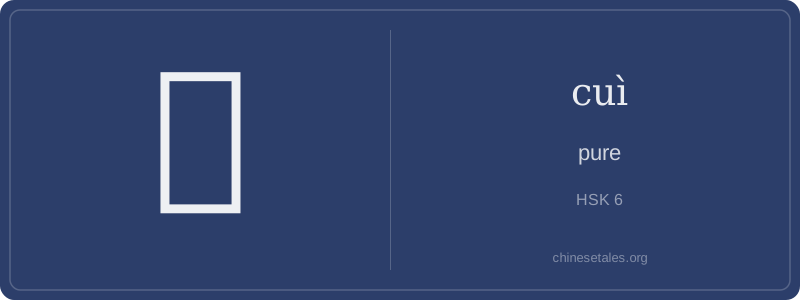
The earliest form of 粹 appears in seal script (around 300 BCE), where it combined 米 (mǐ, ‘rice’) on the left—a radical signaling grain, nourishment, and refinement—with 卒 (zú, ‘soldier’ or ‘finally, at last’) on the right, acting phonetically *and* semantically. 卒 originally depicted a person kneeling with hands bound—suggesting completion, exhaustion, or finality. So visually, 粹 was ‘grain brought to its final, perfected state’: the rice fully winnowed, every husk and chaff removed. Over centuries, 卒 simplified from a complex kneeling figure into today’s 8-stroke form, while 米 retained its distinctive ‘rice grains’ shape—four dots under a roof-like top.
This grain-based origin cemented 粹’s meaning as ‘the finest part obtained after thorough processing’. By the Han dynasty, it appeared in texts like the *Huainanzi*, describing ‘the pure essence of the Dao’—not mystical purity, but the concentrated wisdom extracted through deep study. The character never lost its agricultural metaphor: just as farmers sifted rice to isolate nutritional gold, scholars sifted ideas to extract enduring truth. Even today, when we say 文化精髓 (wénhuà jīngsuǐ, ‘cultural essence’), we’re echoing that ancient act of careful separation—where purity isn’t passive, but earned through labor.
At its heart, 粹 (cuì) isn’t just ‘pure’ in the water-filtered sense—it’s purity *refined to essence*: the undiluted core of something valuable—be it art, thought, or tradition. Think ‘quintessence’, not ‘distilled water’. It carries weight and reverence: you’d call Confucian ethics a ‘pure essence’ (精粹), not your morning coffee. Grammatically, 粹 almost never stands alone; it’s tightly bound in compounds like 精粹 (jīngcuì) or 国粹 (guócuì), where it functions as a noun or attributive noun—never as a verb or predicate adjective (so you’d never say *‘this tea is 粹’*—that’s ungrammatical!).
Crucially, 粹 always implies *selective refinement*. It’s not inherent purity, but what remains after rigorous sifting—like grain husks removed to reveal the nourishing kernel. That’s why it pairs with 精 (jīng, ‘essence, quintessence’) so often: 精粹 literally means ‘essence + pure essence’—a double emphasis on distilled value. Learners often mistakenly use it like 清 (qīng, ‘clear’) or 纯 (chún, ‘unmixed’), but 粹 is inherently *cultural*, *evaluative*, and *hierarchical*: it signals something has been deemed worthy of preservation.
Culturally, 粹 is deeply tied to heritage conservation and intellectual elitism—especially in phrases like 国粹 (‘national quintessence’, e.g., Peking opera or calligraphy). Misusing it risks sounding pretentious or anachronistic. Also, watch tone: cuì (4th) is easily confused with cuī (1st, ‘urge’) or cuǐ (3rd, ‘jade flaw’)—but those share no semantic link. And unlike 纯, which can describe physical states (纯水, ‘pure water’), 粹 only describes *culturally valued abstractions*.