缘
Character Story & Explanation
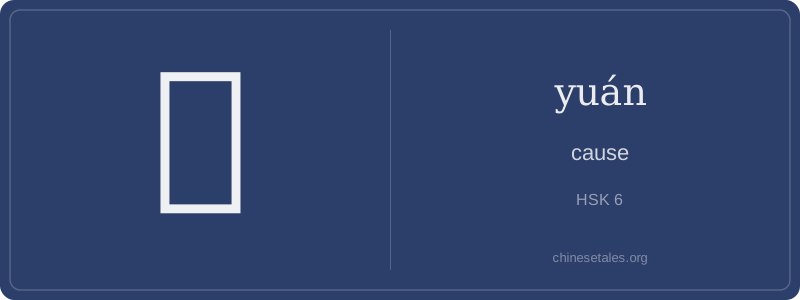
The earliest form of 缘 appears in seal script (c. 3rd century BCE) as a complex compound: left side 糸 (silk thread, simplified to 纟), right side 原 (yuán, ‘source’, ‘spring’), which itself combined ‘water’ (氵) and ‘plain’ (厂 + 泉). Visually, it was a thread flowing from a spring — a vivid image of origin-as-continuity. Over time, the water radical faded, the plain became 口 + 厂, and the silk threads condensed into the modern 纟 radical — but the core idea remained: cause as an organic, flowing source, not a rigid chain.
This visual metaphor shaped its meaning profoundly. In the *Avataṃsaka Sūtra* (Flower Garland Sutra), 缘 describes how all things arise only in dependence on countless interconnected conditions — like ripples from one drop in a still pond. By the Tang dynasty, poets like Bai Juyi used 缘 to express poignant human bonds: ‘同是天涯沦落人,相逢何必曾相识’ — ‘We’re both exiles at life’s edge; why must we have met before to feel this 缘?’ The thread never snaps — it stretches, knots, and re-weaves across time.
At its heart, 缘 (yuán) isn’t just ‘cause’ — it’s the invisible thread that tugs two people across lifetimes, the serendipitous twist that turns chance into destiny. Rooted in silk (the 纟 radical), it evokes something delicate yet unbreakable: not mechanical causation like 因 (yīn), but resonant, karmic connection. In classical Chinese, it often appeared in Buddhist texts describing the interdependent conditions that allow phenomena to arise — think of it as ‘causal entanglement’ with emotional gravity.
Grammatically, 缘 is rarely a standalone verb. You’ll find it most powerfully in fixed phrases like 有缘 (yǒu yuán, 'fated to meet') or 缘分 (yuán fèn, 'karmic bond'), where it functions almost like a noun-modifier. Learners often mistakenly try to use it like English ‘cause’ — saying *‘这个事故的缘是司机疲劳’ — which sounds archaic and unnatural. Instead, native speakers say 缘由 (yuán yóu, ‘reason’) or simply 由于 (yóu yú, ‘due to’). The character prefers poetic weight over logical precision.
Culturally, 缘 carries deep Buddhist and Daoist resonance: it’s why you bump into an old friend on a Tokyo subway, why your childhood piano teacher reappears decades later — not coincidence, but quiet cosmic alignment. Mispronouncing it as yuān (first tone) instead of yuán (second tone) won’t break comprehension, but it subtly undermines the gentle, rising intonation that mirrors the character’s sense of unfolding connection.