翔
Character Story & Explanation
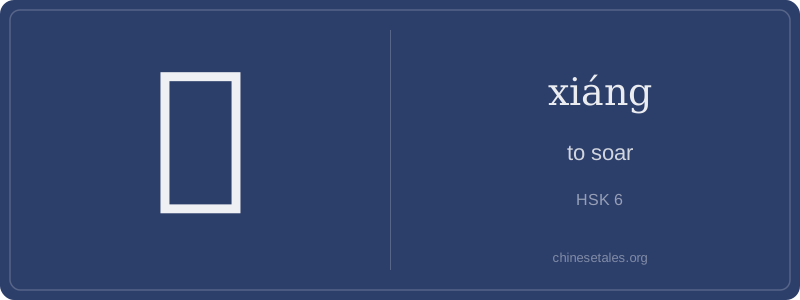
The earliest form of 翔 appears in bronze inscriptions as a stylized bird in mid-air, wings outstretched symmetrically, tail feathers distinct — not flapping, but gliding. Its top component was originally a simplified bird head (a dot + horizontal stroke), evolving into the modern 羊 (yáng) shape by Han dynasty clerical script — not because it means ‘sheep’, but due to phonetic borrowing and stroke simplification. The bottom half has always been 羽 (yǔ, ‘feathers’), anchoring the meaning in avian motion. Over time, the ‘sheep’ top fused visually with the feather base, yielding today’s 12-stroke structure: two horizontal lines (sheep horns), then three strokes (sheep body), capped by six feather strokes — a perfect visual echo of wings unfolding.
This character’s semantic journey is deeply literary. In the Classic of Poetry (Shījīng), 翔 described birds circling before alighting — implying watchful, deliberate movement. By the Han dynasty, it expanded metaphorically: in Sima Qian’s Records of the Grand Historian, it described scholars ‘soaring above vulgar concerns’. Most famously, Fan Zhongyan wrote ‘沙鸥翔集’ (shā ōu xiáng jí — ‘sand gulls soar and gather’) in his 1046 essay — cementing 翔 as the verb of elevated, harmonious presence. Visually, those six feather strokes aren’t decorative: they’re the heartbeat of the character — each stroke a pulse of lift, balance, and quiet power.
翔 (xiáng) isn’t just ‘to fly’ — it’s flight with grace, altitude, and intention. Think of an eagle riding thermal currents, not a sparrow flitting between branches. In Chinese, 翔 implies sustained, unhurried soaring — often poetic, aspirational, or metaphorical. It’s rarely used for everyday verbs like ‘I flew to Beijing’ (that’s 乘飞机 chéng fēijī); instead, it appears in literary, ceremonial, or symbolic contexts: dreams taking flight, ambitions ascending, or spirits rising beyond the earthly realm.
Grammatically, 翔 is almost always a verb — but one that resists casual usage. It’s typically intransitive and formal; you won’t say *‘she 翔ed the kite’* (that’s 放 fàng). You’ll find it in parallel structures (e.g., 翔舞 xiáng wǔ — ‘soar and dance’), classical-style phrases (翔集 xiáng jí — ‘soar and gather’, from Fan Zhongyan’s ‘Yueyang Tower Preface’), or as part of elegant compound nouns (如翔 rú xiáng — ‘like soaring’, meaning ‘gracefully’). Learners often overuse it trying to sound literary — only to sound archaic or unnatural.
Culturally, 翔 carries Daoist and poetic resonance: freedom unbound by gravity or convention. It’s also subtly gendered — historically associated with noble, refined movement (hence its use in names like 李翔 Lǐ Xiáng, evoking excellence and elevation). A common mistake? Confusing it with 飞 (fēi), which is neutral, practical, and ubiquitous. 翔 is the sonnet; 飞 is the text message.