室
Character Story & Explanation
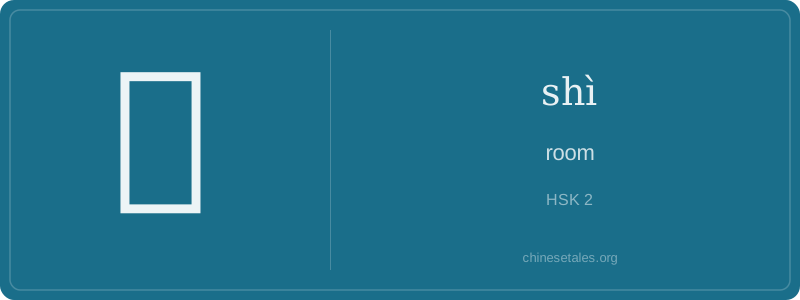
The earliest form of 室 appears in oracle bone inscriptions as a stylized roof (宀) over a square or rectangular enclosure — sometimes with a small dot or stroke inside, representing a person or object within. That roof radical 宀 (mián) — meaning ‘roof’ or ‘cover’ — has remained unchanged for over 3,000 years, anchoring the character’s core idea of shelter. The lower part evolved from 又 (yòu, ‘hand’) plus 一 (a horizontal line), later standardizing into 至 (zhì, ‘to arrive’) — but not as a phonetic loan. In fact, 至 here originally depicted something *placed beneath the roof*, reinforcing containment. By the seal script era, the strokes had settled into today’s nine-stroke form: 宀 (3 strokes) + 至 (6 strokes), with the horizontal stroke of 至 cleanly connecting under the roof.
This visual logic shaped its semantic journey: from ‘enclosed space under a roof’ → ‘private domestic chamber’ (as in Confucius’s Analects 7.31: ‘子入太庙,每事问。或曰:‘孰谓鄹人之子知礼乎?入太庙,每事问。’子闻之,曰:‘是礼也。’’ — where ‘太庙’ contains ritual chambers, implicitly 室). Over time, 室 broadened to include any functional, named interior space — laboratories, offices, even metaphorical ones like 心室 (xīnshì, ‘heart chamber’) — always retaining that sense of intentional, bounded interiority.
At its heart, 室 (shì) isn’t just a neutral ‘room’ — it’s a space imbued with purpose and social gravity. In Chinese thought, a room is rarely empty; it’s defined by what happens inside: studying, resting, worshipping, or hosting guests. That’s why 室 appears in words like 教室 (jiào shì, classroom) and 卧室 (wò shì, bedroom) — the character signals function, not just four walls. It feels more formal and bounded than 房 (fáng), which can mean ‘house’ or ‘room’ but carries looser, more architectural connotations.
Grammatically, 室 almost never stands alone in speech — you’ll rarely hear someone say *‘This is my shì’*. Instead, it’s tightly bound in compound nouns (like 办公室 bàngōngshì, ‘office’) or classical-style phrases (e.g., 寝室 qǐnshì, ‘dormitory room’). Learners often mistakenly use 室 where 房 would sound more natural — saying *‘我的室’* instead of *‘我的房间’* (wǒ de fángjiān), which sounds stiff or even archaic. Also, note that 室 is tone 4 — a sharp, falling pitch — and rhymes with ‘shee’ in ‘machine’, not ‘sheet’.
Culturally, 室 reflects how Chinese conceptualizes interiority: it’s not just physical shelter, but a microcosm of order and role. In classical texts, 室 often appears in ritual contexts — like 祠室 (císhì, ancestral shrine room) — hinting at its early association with reverence and lineage. Modern usage preserves this weight: calling a lab a 实验室 (shíyànshì) subtly elevates it beyond mere ‘space’ to a site of disciplined inquiry.