膨
Character Story & Explanation
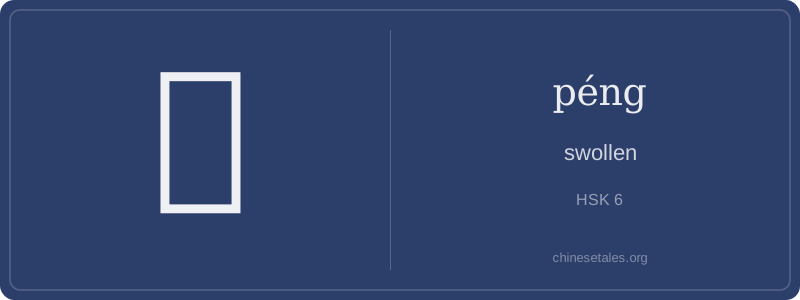
The earliest form of 膨 appears in seal script (c. 3rd century BCE), built from two clear parts: the left side ⺼ (the 'flesh' radical, indicating body-related meaning), and the right side 彭 (péng), which originally depicted drumbeats — not rhythm, but the resonant, vibrating *boom* of a taut drumhead under pressure. In bronze inscriptions, 彭 showed repeated strokes mimicking reverberation. Over centuries, the flesh radical standardized, while 彭 simplified from a complex drum + stone phonetic to today’s clean 12-stroke right component — still echoing vibration, now visually suggesting expansion outward from a center.
This sonic-and-physical fusion shaped its meaning: the 'flesh' radical anchors it in bodily experience (swelling tissue, distended stomach), while 彭 contributes the sense of forceful, resonant, almost explosive growth. By the Han dynasty, 膨 appeared in medical texts like the Huangdi Neijing describing pathological swelling caused by blocked qi — not passive enlargement, but active, pressurized distension. Its modern usage preserves that ancient tension: whether describing inflating balloons, economic bubbles, or inflated resumes, 膨 always whispers, 'This can’t hold.'
Think of 膨 (péng) as Chinese’s version of the word 'bloat' — not just physical swelling, but the kind of inflation that feels slightly alarming, even comical: a balloon about to pop, a budget ballooning out of control, or a rumor swelling into urban legend. In English, 'swollen' is mostly medical or descriptive; in Chinese, 膨 carries an implicit warning — it suggests unnatural, often unsustainable expansion. You’ll rarely see it alone; it almost always appears in compounds like 膨胀 (péngzhàng, 'inflation') or 膨化 (péng huà, 'puffing/puffing up'), where it functions as a verb root or adjective stem.
Grammatically, 膨 is almost never used as a standalone verb (unlike 胀 zhàng, which *can* be). Learners mistakenly say *'tā péng le'* ('he swelled') — but native speakers say *'tā zhàng le'* or *'tā fā zhàng le'*. Instead, 膨 shines in derived forms: 膨胀 means both literal swelling (a tendon) and abstract inflation (prices, egos); 膨化 describes the explosive transformation of corn into popcorn — a perfect visual metaphor for its meaning. It’s also the secret ingredient in bureaucratic euphemisms: 'personnel expansion' becomes 人员膨脹 (rén yuán péngzhàng), softening the blunt reality of overstaffing.
Culturally, 膨 subtly echoes Daoist and medical warnings against excess — too much qi, too much ambition, too much growth. A common learner trap is overgeneralizing it to any 'big' or 'large' context; remember: 膨 implies *pressure-building, unstable increase*, not neutral size. Also, avoid confusing it with 篷 (péng, 'tent canvas') — same sound, totally unrelated. If you hear 膨 in a news report, brace for bad economic data or a cautionary tale about unchecked growth.