腻
Character Story & Explanation
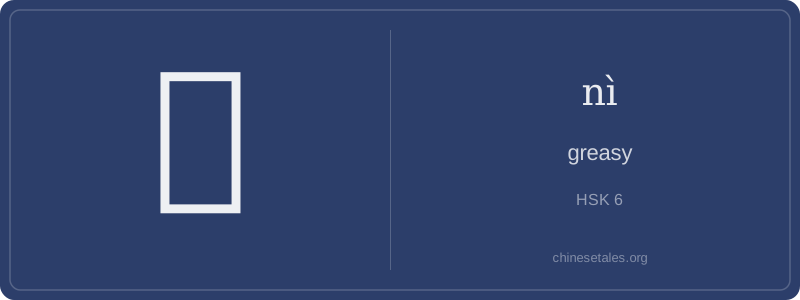
The earliest form of 腻 appears in seal script (c. 3rd century BCE), where it clearly combines ⺼ (a variant of 月, meaning ‘flesh’ or ‘body part’, used here for its semantic link to physical sensation) on the left with 尼 (ní) on the right — not as a random phonetic, but as a carefully chosen component. 尼 originally depicted a kneeling person (尸 + 匕), symbolizing submission or closeness — and in 腻, it subtly evokes the clinging, suffocating quality of excess fat or intimacy. Over centuries, the flesh radical standardized into ⺼, while 尼 lost its kneeling legs and became stylized into today’s clean, compact shape — yet the sense of ‘pressing close, sticking too tightly’ remained embedded in every stroke.
This visual logic shaped its semantic evolution: in early texts like the *Shuowen Jiezi* (121 CE), 腻 was defined as ‘smooth and dense’ (滑而密), referring first to texture — fatty meat, glossy lacquer, even fine silk. By the Tang and Song dynasties, it expanded metaphorically: poets used 腻 to describe overly ornate language (‘flowery to the point of suffocation’) or excessive affection (‘love so thick it chokes’). The Ming novel *Jin Ping Mei* famously uses 腻 to critique decadence — not just greasy food, but the moral stickiness of indulgence. Its enduring power lies in that perfect fusion: body (⺼) + clinging proximity (尼) = a word that feels heavy on the tongue before you even speak it.
At its core, 腻 (nì) isn’t just ‘greasy’ in the kitchen-sense — it’s the visceral feeling of *too much*: too much oil on your tongue, too much sweetness in a dessert, too much closeness in a relationship. It carries a subtle layer of discomfort or cloying saturation — think of biting into a cake so rich it coats your mouth, or hearing the same joke for the fifth time. This character thrives in sensory and emotional contexts, never in neutral descriptions: you’d say 这汤太腻了 (this soup is too greasy), not simply 这汤很腻 (this soup is greasy) — because 腻 almost always implies excess and mild aversion.
Grammatically, 腻 is most commonly an adjective used after 很, 太, or 不, and frequently appears in the pattern [noun] + 太/有点/真 + 腬. It can also function as a verb meaning ‘to become bored of’ or ‘to feel fed up with’ — especially in colloquial speech: 我都腻了 (wǒ dōu nì le) — ‘I’m totally over it.’ Crucially, it’s rarely used predicatively without a degree adverb; saying *这菜腻* (without 太/有点) sounds incomplete or dialectal to most native speakers.
Culturally, 腻 reveals how Chinese evaluates balance: food should be harmonious — not too dry, not too oily, not too sweet — and 腻 marks the precise moment harmony tips into overload. Learners often mistakenly use it like English ‘greasy’ (e.g., *the pan is greasy*) — but 腻 describes *perceived sensory saturation*, not physical residue. Also, don’t confuse it with 厌 (yàn, ‘to loathe’) — 腻 is milder, more bodily, and often self-deprecating: 我吃腻了牛肉 (I’ve gotten sick of beef) expresses gentle fatigue, not moral disgust.