臂
Character Story & Explanation
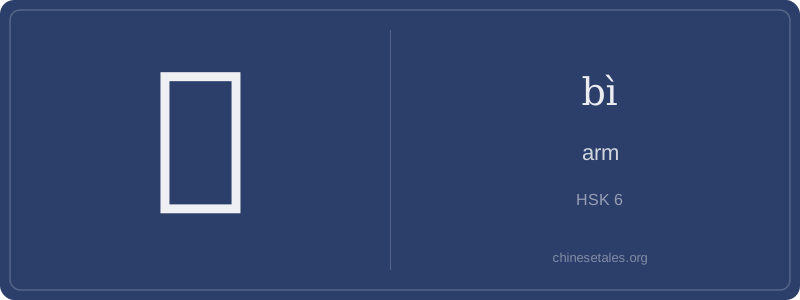
The earliest form of 臂 appears in late Western Zhou bronze inscriptions as a complex pictograph: a simplified human figure with an exaggerated, bent limb extending outward — clearly emphasizing the upper arm’s articulation at the shoulder and elbow. Over centuries, the figure shrank and stylized: the head and torso condensed into the ⺼ (flesh) radical on the left, while the right side evolved from a curved line representing the bent arm into today’s intricate 17-stroke component — note how the top strokes mimic a raised shoulder, the middle loops echo the elbow’s hinge, and the final downward strokes suggest the forearm descending.
This visual logic endured: in the Shuōwén Jiězì (121 CE), Xu Shen defined 臂 as ‘the part between the shoulder and elbow’, confirming its anatomical precision. By the Tang dynasty, poets like Du Fu used 臂 metaphorically — ‘双臂如铁’ (shuāng bì rú tiě, ‘arms like iron’) — linking physical strength to moral fortitude. The character never absorbed colloquial meanings; while 胳膊 became the spoken word, 臂 stayed rooted in writing, medicine, and ritual — its form a fossilized snapshot of how ancient Chinese saw the body as a hierarchy of functional limbs, not just appendages.
Imagine a martial arts master in a misty mountain temple, demonstrating a powerful move: he raises his arm — not just the forearm, but the whole limb from shoulder to wrist — and says firmly, bì. That’s 臂: not the casual ‘arm’ of everyday English, but the formal, anatomical, often literary or technical term for the entire upper limb. It’s the word you’d see in medical textbooks, classical poetry, or official documents — never in ‘arm wrestle’ (that’s 手臂 or just 手) or ‘give someone a hand’ (手). Its feel is precise, weighty, slightly archaic.
Grammatically, 臂 rarely stands alone; it almost always appears in compounds like 手臂 (shǒu bì, ‘arm’ in neutral speech) or 左臂 (zuǒ bì, ‘left arm’). You’ll almost never say ‘我的臂’ — that sounds stiff and unnatural. Instead, it’s embedded: ‘他挥动右臂’ (tā huī dòng yòu bì — ‘He swung his right arm’), where 臂 specifies the *whole* limb in motion. Learners often overuse it solo, confusing it with 手 (hand) or 胳膊 (gē bo, colloquial ‘arm’ — which includes both upper and lower parts).
Culturally, 臂 carries subtle resonance: in classical texts like the Zuo Zhuan, ‘断臂’ (duàn bì, ‘to sever the arm’) symbolizes irreversible sacrifice or loyalty — think of Yue Fei’s mother tattooing ‘serve the country with utmost loyalty’ on his back, not his arm, precisely because 臂 conveys physical agency and action. A common mistake? Writing 臂 as 臂 (correct) vs. 臂 (with wrong radical) — the ⺼ (flesh) radical is non-negotiable: this is literally *flesh of the body*, not wood (木) or speech (言).