臣
Character Story & Explanation
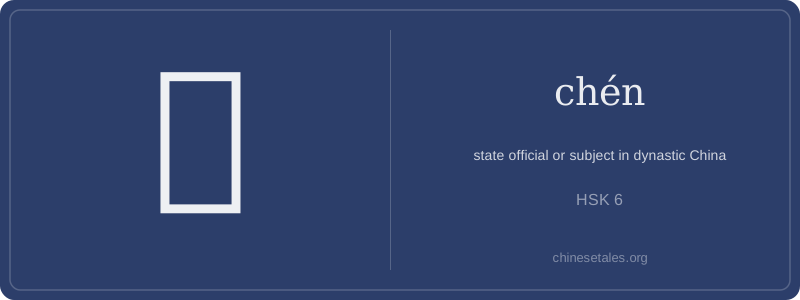
The earliest form of 臣 appears in oracle bone inscriptions as a stylized eye — not just any eye, but one with an exaggerated, elongated pupil and heavy lid, drawn sideways to suggest a person bowing low with eyes downcast in submission. Over time, the ‘eye’ became more angular; bronze script added symmetry and thickness, then Qin small seal script standardized the two parallel horizontal strokes above and below the central vertical line — representing bowed head, lowered gaze, and rigid posture. By the Han clerical script, the six-stroke structure we know today was locked in: two horizontals (bowed brow), two short verticals (folded arms?), and two longer verticals (kneeling body and extended sleeve — or perhaps stylized chains of loyalty).
This visual origin directly shaped its meaning: from ‘a person with downcast eyes in service’ to ‘subject’ or ‘minister’ — always implying voluntary submission to higher authority. In the Zuo Zhuan, ministers refer to themselves as 臣 when pledging fealty; Mencius argued that a ruler who loses virtue forfeits the people’s obligation to remain 臣. Even today, the character’s rigid, symmetrical shape evokes unwavering duty — no flourish, no deviation, just six disciplined strokes mirroring the Confucian ideal of moral rectitude under hierarchy.
Imagine a solemn court scene in the Han dynasty: a high-ranking official kneels on cold marble, forehead touching the floor before the emperor — not out of fear alone, but as a ritualized embodiment of duty, loyalty, and hierarchical order. That’s 臣 (chén) in action: it’s not just ‘official’ or ‘subject’ — it’s a relational identity, defined entirely by its position *relative to the ruler*. It carries weight, humility, and moral responsibility — think Confucius’s ‘ruler must rule rightly; subject must serve loyally.’
Grammatically, 臣 functions mainly as a noun (‘minister,’ ‘vassal’) or classical pronoun meaning ‘your humble servant’ — used reflexively by officials when addressing superiors (e.g., 臣以为… ‘This humble servant believes…’). Modern Mandarin rarely uses it conversationally, but it appears frequently in historical dramas, formal writing, and fixed expressions like 忠臣 (zhōng chén, ‘loyal minister’). Learners often mistakenly treat it as a generic synonym for ‘employee’ — but 臣 implies feudal allegiance, not contractual employment.
Culturally, 臣 reflects China’s deep-rooted ‘ruler-subject’ axis — one of the Five Relationships in Confucianism. Misusing it (e.g., calling yourself 臣 in casual speech) sounds absurdly archaic or sarcastic. Also beware: in ancient texts, 臣 could even be used as a verb meaning ‘to serve as a subject to’ — a usage vanished in modern speech but still tested in HSK 6 reading comprehension.