舌
Character Story & Explanation
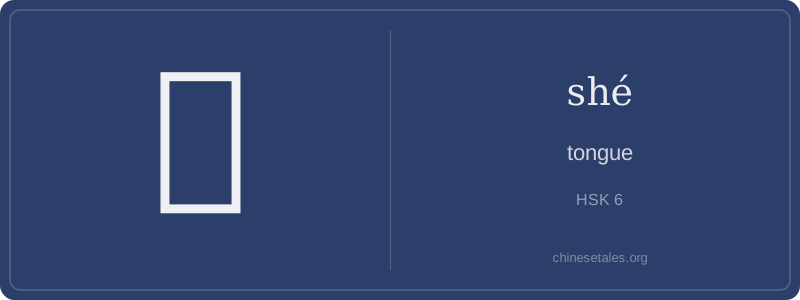
The earliest form of 舌 appears in oracle bone inscriptions (c. 1200 BCE) as a vivid pictograph: a mouth (口) with a bold, wavy line protruding downward — unmistakably a tongue curling out, sometimes even dotted to suggest taste buds. Over centuries, the mouth simplified into the top three strokes (the 'lid' and two sides), while the wavy tongue condensed into the lower three strokes — first a curve, then a sharp hook, finally settling into today’s clean, slightly tilted 'knife-like' shape: the horizontal stroke (一), the descending left-falling stroke (丿), and the decisive dot (丶) — mimicking the tongue’s tip flicking forward.
This visual honesty lasted millennia: in the Shuōwén Jiězì (100 CE), Xu Shen defined 舌 as 'the organ within the mouth that tastes and speaks', confirming its dual sensory-linguistic role. By the Tang dynasty, poets like Bai Juyi used 舌 metaphorically — 'my tongue freezes mid-sentence' (舌强不能言) to convey shock — proving its semantic range had already expanded from anatomy to psychology. Even today, the character’s shape whispers its function: that final dot? It’s not decorative — it’s the tongue’s tip, poised to taste, speak, or betray.
Think of 舌 (shé) not just as 'tongue' — but as Chinese’s linguistic Swiss Army knife: it’s both the literal organ *and* the metaphorical engine of speech, taste, and even deception. In English, we say 'sharp tongue' or 'slip of the tongue'; in Chinese, 舌 is the quiet star behind all of them — carrying visceral weight, like calling someone a 'poisonous tongue' (毒舌) to mean brutally honest critic, not just 'sarcastic person'. It’s never neutral; it pulses with personality.
Grammatically, 舌 rarely stands alone in modern speech — you’ll almost always see it in compounds (e.g., 口舌 for 'verbal dispute', 舌头 for colloquial 'tongue'). Crucially, it’s *not* used like English ‘tongue’ in idioms such as 'mother tongue' — that’s 母语 (mǔyǔ), not 母舌! Learners often mistakenly insert 舌 where native speakers use 语 or 言; saying *母舌* sounds like a botched medical term, not a language.
Culturally, 舌 has ancient clout: Confucius warned against 'hurting others with the tongue' (伤人以言,深于矛戟), and traditional medicine maps flavors and health directly onto the tongue’s appearance — so when your doctor asks you to 'stick out your tongue' (伸舌头), it’s not just routine — it’s a diagnostic portal. And yes, that’s why 'sweet tongue' (甜舌) isn’t a compliment — it’s suspiciously flattering, almost manipulative. The tongue doesn’t lie… but it sure can persuade.