苟
Character Story & Explanation
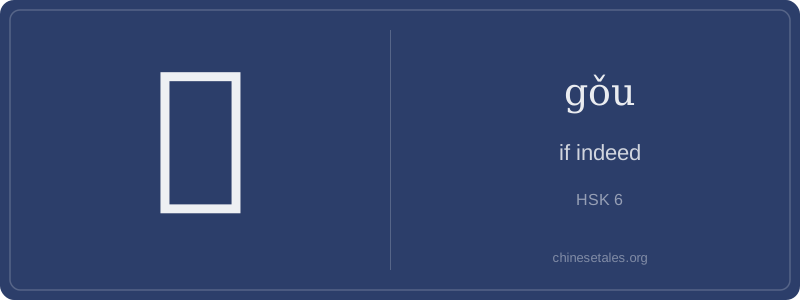
The earliest form of 苟 appears on Warring States bamboo slips — not as grass (艹), but as a stylized depiction of a *dog’s head with a drooping tongue*, written 艸 + 句 (a phonetic component). Wait — dog? Yes! The original oracle bone and bronze forms show a canine profile with exaggerated jowls, symbolizing *lowly, base, or unrefined behavior*. Over centuries, the dog-head morphed into the top component we now read as 艹 (grass radical) purely by graphical simplification — a classic case of ‘shape drift’ where meaning outlived the pictograph. By the Han dynasty, scribes standardized it as 艹 + 句, cementing its eight-stroke structure.
Meaning-wise, 苟 began as an adjective meaning ‘careless, sloppy, or undisciplined’ — think of a dog lolling lazily in the dust. But through classical usage, it underwent semantic elevation: its association with *unexamined action* gave rise to the adverbial sense ‘hastily, without due care’, and eventually, the conditional ‘if indeed’ — implying that *only if one acts with full awareness and seriousness* does the consequence follow. Mencius famously used it in ‘苟不充之,不足以事父母’ (‘If indeed one does not fully develop this [benevolent heart], one cannot serve one’s parents’), turning a word for canine laxity into a cornerstone of moral reasoning.
Imagine you’re debating with a classical Chinese scholar in a misty mountain pavilion. He leans forward, finger tapping the bamboo scroll, and says: ‘Gǒu yǒu bìng, bù kě shì yě’ — ‘If indeed there is illness, it must not be ignored.’ That little gǒu isn’t just ‘if’ — it’s a weighty, almost solemn conditional: it signals sincerity, inevitability, and moral gravity. In modern usage, it rarely stands alone; it’s almost always paired with yǒu, wéi, or bù to form phrases like gǒu yǒu (‘if indeed there is’) or gǒu wéi (‘if truly it is’). Think of it as the ‘for real’ of classical logic — not casual speculation, but a hinge upon which truth and consequence pivot.
Grammatically, gǒu is a pre-classical conjunction that survives almost exclusively in literary or rhetorical contexts — speeches, essays, formal writing, or set phrases. You’ll never hear it in daily conversation like rúguǒ or yàoshi. Learners often mistakenly use it as a standalone ‘if’, or confuse it with jì (‘since’) — but gǒu always implies *conditional certainty*: not ‘maybe’, but ‘*given that this is true*, then…’. Its power lies in its austerity: 8 strokes, no frills, and zero tolerance for ambiguity.
Culturally, gǒu carries Confucian resonance — it appears in the Mencius and Zuo Zhuan to introduce ethical imperatives. A common mistake? Overusing it in spoken Chinese or mixing it up with gǒu as a surname (e.g., 苟姓) — but that’s orthographically identical and contextually unrelated. Remember: in grammar, gǒu is never about people — it’s about truth conditions, like a logical gatekeeper in ink.