帮
Character Story & Explanation
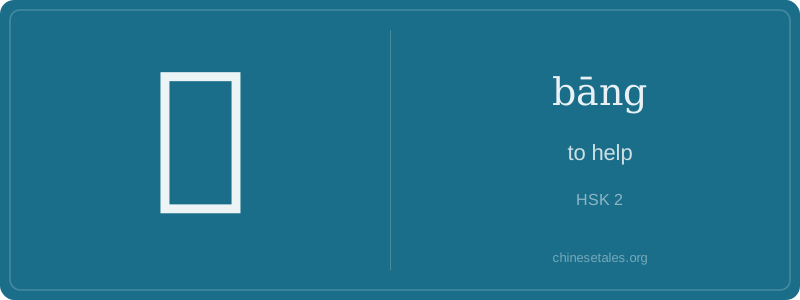
The earliest form of 帮 appears in seal script, not oracle bone — and it’s a brilliant visual pun. The left side 巾 (jīn) means ‘cloth’ or ‘towel’, while the right side 封 (fēng) originally depicted a tree (木) under a mound (土) with ritual seals — symbolizing ‘to seal’ or ‘to enclose’. But here, 封 wasn’t used for its meaning; it was borrowed for its sound (fēng → bāng via historical phonetic shift). So visually, it’s ‘cloth + sealed enclosure’ — but that’s just the shell. The real magic is in the evolution: over centuries, the right side simplified from 封 to the modern + 几 shape, keeping the 9-stroke count and the balanced, upright posture of mutual support.
In classical texts, 帮 first appeared in the Song dynasty as a colloquial term meaning ‘to assist’ or ‘to prop up’, especially in vernacular novels like Water Margin, where outlaws ‘help each other survive’ (互相帮忙, hùxiāng bāngmáng). Its cloth radical 巾 is no accident — cloth wraps, binds, and supports, just as help holds relationships together. Unlike formal verbs like 助 (zhù), 帮 grew from the ground up, rooted in daily life — making it one of the first ‘help’ words learners hear, precisely because it feels human, not bureaucratic.
At its heart, 帮 (bāng) isn’t just ‘to help’ — it’s about *mutual, hands-on support*, often in everyday, practical contexts. Think of lending a hand to carry groceries, proofreading a friend’s essay, or holding the door open. It carries warmth and informality, rarely used for grand, abstract, or institutional aid (that’s more 助 or 援). You’ll hear it constantly in spoken Mandarin: ‘Can you help me?’ is almost always 你能帮我吗?(nǐ néng bāng wǒ ma?), not 你能助我吗?— the latter sounds stiff, even literary.
Grammatically, 帮 is wonderfully flexible. As a verb, it takes a direct object (帮 + person + verb/object), like 帮我买咖啡 (bāng wǒ mǎi kāfēi — ‘help me buy coffee’). Crucially, it can also be used with the structure 帮…(把)+ object + verb — a subtle but essential pattern meaning ‘help someone handle/do something’: 帮我把书拿过来 (bāng wǒ bǎ shū ná guòlái). Learners often omit the 把 or misplace the object — a tiny slip that makes the sentence sound unnatural or incomplete.
Culturally, 帮 reflects the Chinese value of *reciprocal relational duty* — helping isn’t just kindness; it’s how trust and social bonds are woven. That’s why 帮忙 (bāngmáng) — literally ‘help + busy’ — is the most common polite phrase for ‘to help’, softening the request. A classic mistake? Using 帮 alone as a noun (e.g., ‘I need your 帮’) — nope! It’s always 帮忙 or 帮助. Also, don’t confuse it with 拜托 (bàituō), which is more like ‘I’m entrusting you’ — respectful, but not active assistance.