床
Character Story & Explanation
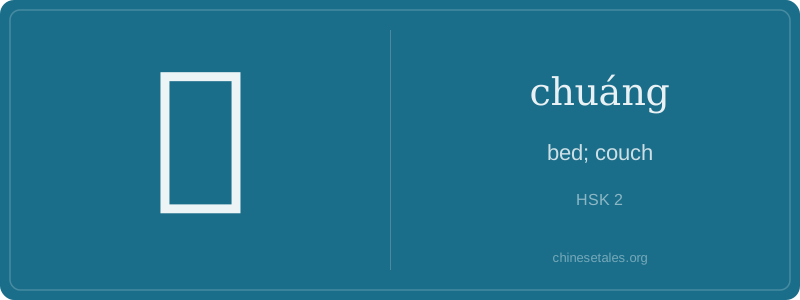
The earliest form of 床 appears in Han dynasty bamboo slips — not as a detailed picture, but as a simplified ideograph: the radical 广 (a shelter or roof-like cover) on the left, and 木 (wood) on the right, written as ⺝ + 木. Originally, it depicted a raised wooden platform under a simple roof — a basic sheltered sleeping surface. Over centuries, 木 condensed into the three-stroke shape we see today (丶一丿), while 广 kept its sweeping left-falling stroke. By the Tang dynasty, the character stabilized into its current 7-stroke form: a wide ‘roof’ cradling a compact ‘wood’ — visually echoing how a bed supports the body beneath cover.
This visual logic reflects its semantic journey: from concrete ‘wooden platform under shelter’ to abstract ‘place of rest’. Intriguingly, in Li Bai’s 7th-century poem ‘Quiet Night Thoughts’, the line ‘床前明月光’ likely refers not to a modern mattress-bed, but to a low, couch-like sitting/sleeping platform common in aristocratic homes — blurring the line between ‘bed’, ‘sofa’, and ‘daybed’. That ambiguity lingers: even today, 床 can mean ‘couch’ in northern dialects or informal speech, revealing how deeply function — not form — defines this character.
Imagine waking up in a Beijing apartment at dawn, sunlight slanting across your chuáng — not just any bed, but the warm, slightly creaky wooden frame where you slept, ate breakfast, and even video-called your family. In Chinese, 床 isn’t just ‘bed’ as furniture; it’s a quiet anchor of daily life — intimate, personal, and surprisingly versatile. It can mean a sleeping platform (like a traditional kàng), a hospital cot (yīyuàn de chuáng), or even a riverbed (héchuáng) — though that last one is more literary and rare at HSK 2.
Grammatically, 床 is a simple noun: no measure word needed when counting (e.g., yì zhāng chuáng uses 张, but you’ll often hear zhè chuáng for ‘this bed’ without repeating the classifier). Learners sometimes overgeneralize and say *wǒ shuì chuáng* — but no! You sleep on the bed: wǒ shuì zài chuáng shàng. The preposition shàng (on) is nearly mandatory here — skipping it sounds like you’re sleeping *as* the bed!
Culturally, 床 carries soft warmth — think of parents tucking kids in (gài hǎo bèi zi, shuì jué le), or the poetic melancholy in Li Bai’s famous line ‘chuáng qián míng yuè guāng’ — where ‘bed’ may have originally meant a sleeping *couch* or even a low stool (more on that in the story!). Don’t confuse it with Western ‘bedroom’ connotations: Chinese homes rarely have dedicated bedrooms, so 床 often lives in multi-purpose rooms — making it feel less private, more lived-in and real.