弟
Character Story & Explanation
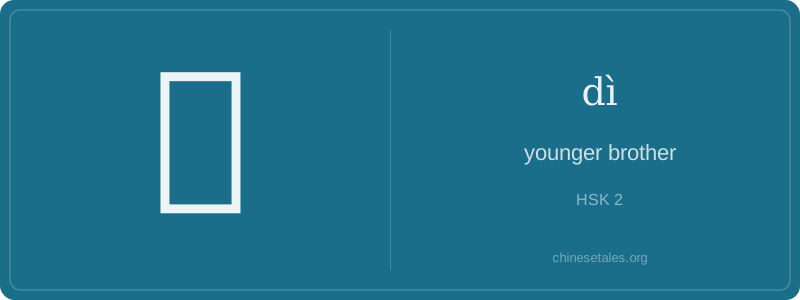
The earliest form of 弟 appears on Shang dynasty oracle bones as a pictograph resembling a bent bow (弓) with a hand (又) gripping it — not as a weapon, but as a symbol of *submission*: the younger sibling bowing respectfully before elders. Over centuries, the hand morphed into the top-left component (⺮-like stroke), and the bow radical 弓 settled firmly at the bottom — now visually anchoring the character’s meaning in humility and posture. By the Qin seal script, 弟 had stabilized into a 7-stroke structure: three strokes above (representing bowed head and arms), then the strong, curving 弓 base — like a younger person kneeling *on* the family ‘bow’ of tradition.
This physical bow evolved into moral posture: in the *Classic of Filial Piety*, 弟 is paired with 孝 (xiào, filial piety) as *tì* — fraternal respect, the twin pillar of social harmony. Mencius praised those who ‘treat their elder brothers as teachers’, making 弟 not just biological but ethical. Even today, calling someone 小弟 isn’t about age — it’s a performative gesture of humility, echoing that ancient bow. The character’s enduring shape — bow beneath gesture — quietly reminds us: in Chinese thought, respect isn’t spoken; it’s *bodied*.
At its heart, 弟 (dì) is all about family hierarchy and respectful closeness — it doesn’t just mean 'younger brother'; it embodies the Confucian value of *dì* (younger sibling respect), where age order dictates both address and attitude. Unlike English’s neutral 'brother', 弟 carries quiet warmth and duty: you call your younger brother 弟, but never your older one — that’s 哥 (gē) or 兄 (xiōng). It’s a noun first, but also appears in honorifics like 小弟 (xiǎo dì, 'your humble younger brother') — a self-deprecating term men use when speaking to elders or superiors.
Grammatically, 弟 rarely stands alone in modern speech; it’s usually paired: 我弟弟 (wǒ dì di, 'my younger brother'), 他弟弟 (tā dì di, 'his younger brother'). Note the reduplication — dì di — which softens the term and signals familiarity (HSK 2 learners should always use this doubled form in everyday contexts). A common mistake? Using 弟 for *any* brother — but no: it’s strictly younger. Say 我弟弟 and you’re safe; say 我弟 without context, and native speakers may pause, wondering if you’re being abrupt or poetic.
Culturally, 弟 reflects how Chinese kinship terms encode relationship *and* power. In classical texts like the *Analects*, 'elder brother' (兄) commands deference, while 弟 receives gentle guidance — but also responsibility. Interestingly, 弟 is rarely used as a standalone pronoun (unlike 哥), and never for non-relatives unless jokingly ('You’re my little brother in spirit!'). Learners sometimes overuse it in formal writing — stick to 我弟弟 or 小弟 in speech, and avoid bare 弟 in essays.