荤
Character Story & Explanation
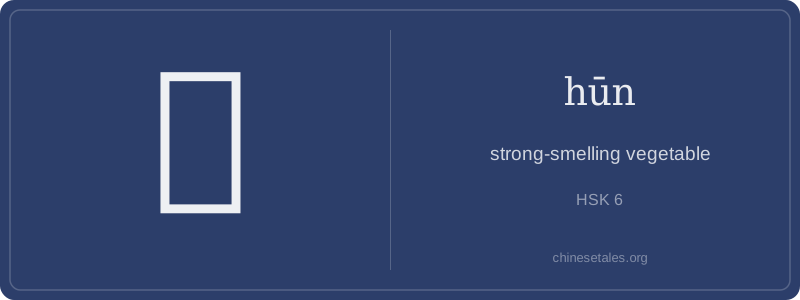
The earliest form of 荤 appears in Han dynasty bamboo slips as a compound: top 艹 (grass radical) + bottom 昏 (hūn, 'dusk' or 'confusion'). It wasn’t pictographic like ox or sun — it was semantic-phonetic: 艹 signals plant origin; 昏 provides pronunciation *and* hints at meaning — dusk is murky, disorienting; so are these pungent plants, which ancient physicians believed 'clouded the mind' and disturbed meditative clarity. Over centuries, the lower component simplified from 昏’s full form (日 + 旾) to today’s streamlined 昏 — nine strokes total, with the grass radical neatly crowning two horizontal lines, a vertical stroke, and the compact 'sunset' shape beneath.
This character crystallized during the Eastern Jin dynasty (4th c. CE), when Daoist and Buddhist dietary codes formalized the 'five pungent roots' (wǔ hūn): garlic, onion, leek, chive, and asafoetida. The Tang dynasty poet Bai Juyi wrote of abstaining from 荤 to purify his 'qi', and Ming medical texts warned that overeating 荤 'stirs liver fire'. Visually, the character’s structure reinforces its concept: the gentle, covering 艹 above, and beneath it — 昏, evoking mental fog, sensory overwhelm, and the dimming light that makes strong smells linger heavier in the air.
Think of 荤 (hūn) as Chinese cuisine’s version of 'stinky cheese' — not meat, not vegetarian, but a whole third category defined by pungency and cultural taboo. In English, we say 'meat and vegetables', but in Chinese Buddhist, Daoist, and traditional health contexts, the real binary is 荤 (strong-smelling plants) vs. 素 (mild, neutral plants). Garlic, onions, leeks, chives, and ginger — all count as 荤, even though they’re botanically vegetables. This trips up learners who assume 'vegetarian = no meat only'; in China, strict vegetarians avoid 荤 entirely.
Grammatically, 荤 is almost never used alone. It appears in compounds like 荤菜 (hūn cài, 'pungent vegetable dish') or in contrastive phrases: 这道菜是荤的 (zhè dào cài shì hūn de, 'This dish is *hūn*') — where 的 turns it into an adjective meaning 'containing strong-smelling ingredients'. You’ll also see it in the classic pair 荤素搭配 (hūn sù pǐn pèi, 'balanced mix of pungent and mild foods'), a nutrition principle rooted in yin-yang theory.
Culturally, calling something 荤 isn’t about taste — it’s about qi (vital energy). Ancient texts like the Taishang Ganying Pian list five specific 'five pungent roots' (wǔ hūn) believed to stir desire and cloud meditation. Learners often misread 荤 as 'meat' because of its radical 艹 (grass), yet it’s *not* related to 肉 (ròu, 'meat') — a crucial distinction. Confusing them could turn your 'garlic-free temple meal' into a 'meat-free temple meal'… with unintended spiritual consequences.