藐
Character Story & Explanation
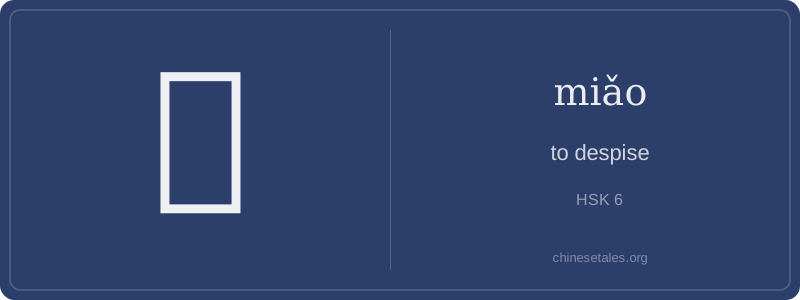
The earliest form of 藐 appears in Warring States bamboo texts — not as a pictograph, but as a phonosemantic compound already fully formed. Its left side, 艹 (cǎo, ‘grass’), is the radical — not because it’s about plants, but because many characters with abstract or negative connotations borrowed this ‘soft, low-growing’ radical to imply diminishment or insignificance. The right side, 廌 (zhì), was originally a mythical one-horned ‘justice beast’ from oracle bone script — symbolizing discernment and moral clarity. Over centuries, 廌 simplified into the modern 亠 + 幺 + 丨 + 口 shape we see today, losing its horn but keeping its judicial gravity.
This fusion tells a subtle story: ‘grass-level judgment’ — seeing something as so trivial or unworthy it’s like trampling weeds. By the Han dynasty, 藐 appeared in the *Shuōwén Jiězì* dictionary defined as ‘to look down upon; to regard as small.’ It gained philosophical heft in Daoist and Neo-Confucian texts, where sages ‘despised’ worldly power not out of pettiness, but from transcendent perspective — like a mountain overlooking ants. That vertical gaze — downward, calm, unshakable — remains embedded in every stroke.
At its core, 藐 (miǎo) isn’t just ‘to despise’ — it’s a quietly fierce, almost aristocratic dismissal: to regard something as so beneath notice that it doesn’t even merit anger. Think less ‘I hate you’ and more ‘You’re not even on my radar.’ It’s a literary, slightly archaic verb that conveys intellectual or moral superiority — often used in formal writing, classical allusions, or biting satire. You’ll rarely hear it in casual speech; instead, it appears in essays, political commentary, or when describing haughty scholars or cynical philosophers.
Grammatically, 藐 is transitive and usually takes a noun or pronoun object (e.g., 藐视权威). It pairs naturally with formal nouns like 权威 (authority), 法律 (law), or 传统 (tradition). Crucially, it almost never stands alone — it nearly always appears in the compound 藐视 (miǎoshì), meaning ‘to scorn’ or ‘to treat with contempt.’ Learners sometimes mistakenly use it like 看不起 (kàn bu qǐ), but 藐 carries heavier rhetorical weight and zero colloquial warmth.
Culturally, 藐 reflects Confucian tension: while respect (敬) is foundational, the act of *deliberately* lowering one’s gaze — visually and morally — signals profound judgment. A common learner trap? Using it reflexively for everyday disdain (e.g., ‘I despise broccoli’) — nope! That’s 讨厌 (tǎoyàn). 藐 belongs in essays about colonial arrogance or critiques of dogmatic ideology. Also, watch the tone: miǎo is third tone, but learners often misread it as miào (fourth tone) — which means ‘wonderful’… the opposite energy entirely!