虐
Character Story & Explanation
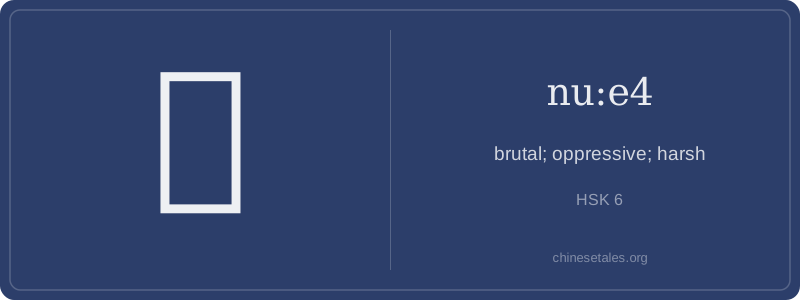
The earliest form of 虐 (oracle bone script, c. 1200 BCE) was a chilling pictograph: a tiger’s head (虍, the radical) looming over a kneeling person with arms bound — literally ‘tiger crushing a captive’. Over centuries, the kneeling figure simplified into the lower component 卩 (jié, ‘kneeling person’), while the tiger’s head evolved into the upper 虍 (hū), retaining its fierce, clawed outline. By the seal script era, the nine strokes locked into place: three bold strokes for the tiger’s brow and snarl, then six precise lines forming the bound, submissive figure beneath — every stroke a visual echo of domination.
This image wasn’t metaphorical — it reflected Shang dynasty warfare and ritual sacrifice, where tigers symbolized raw, untamable power. By the Warring States period, philosophers like Mencius repurposed 虐 to condemn *human* cruelty, writing ‘暴其民甚,则身弑国亡’ (if a ruler abuses his people severely, he will be killed and his state destroyed). The character’s structure became a moral diagram: the oppressive force (虍) literally *overwrites* the vulnerable (卩). Even today, when Chinese readers see 虐, their eyes instinctively trace that top-down pressure — a 3,000-year-old visual warning etched into the script.
At its core, 虐 isn’t just ‘harsh’ — it’s the visceral weight of systemic cruelty: a ruler overstepping mandate, a boss exploiting labor, or even self-inflicted emotional torment (like ‘self-torturing’ over a breakup). In Chinese moral logic, 虐 implies a *power imbalance*: the perpetrator holds authority (real or perceived), and the suffering is *intentional, sustained, and unjust*. That’s why you’ll rarely hear 虐 used for fleeting frustration (‘This math problem is brutal!’) — that’s 太难了 or 烦死了. Instead, 虐 appears where ethics are breached: ‘The factory owner 虐待 workers’ (not just ‘treats them badly’ but ‘subjects them to dehumanizing conditions’).
Grammatically, 虐 almost never stands alone as a verb — it’s nearly always in compound verbs like 虐待 (nuèdài, ‘to abuse’) or as an adjective in literary/formal contexts (e.g., 虐政 ‘tyrannical rule’). Learners often mistakenly use it like English ‘brutal’ — say, ‘The test was 虐!’ — but native speakers would say ‘考试太变态了!’ or ‘卷疯了!’. 虐 needs a human agent or institutional force behind the harm; it’s not about difficulty, but about *moral violation*.
Culturally, 虐 carries Confucian gravity: Mencius famously declared ‘闻其声不忍食其肉’ (hearing the ox’s cry, he couldn’t bear to eat its flesh), condemning rulers who 虐民 — harming the people violates Heaven’s Mandate. Modern usage extends this to digital spaces: ‘网络暴力’ (cyberbullying) is sometimes called ‘精神虐待’, linking ancient ethical frameworks to 21st-century harm. The biggest trap? Using 虐 casually. It’s a heavy word — like dropping ‘genocide’ into small talk. Respect its weight, and you’ll sound fluent, not flippant.