虏
Character Story & Explanation
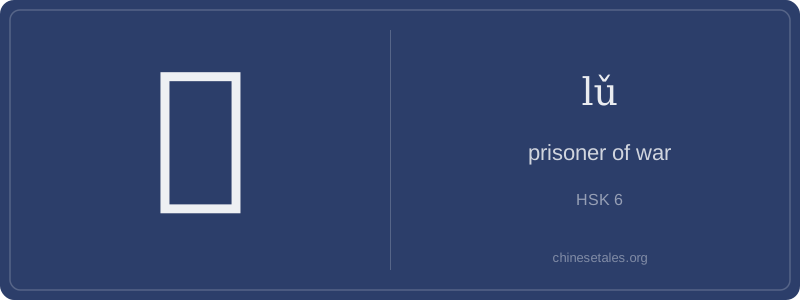
The earliest form of 虏 appears on Shang oracle bones as a vivid scene: a tiger-head radical (虍) looming over a kneeling human figure (now simplified to the lower part 男, but originally depicted with arms bound and head bowed). That tiger wasn’t decorative — it symbolized the ferocity and dominance of the captor. Over centuries, the kneeling person evolved into the component 男 (nán, ‘man’), not because captives were always male, but because 男 itself was originally a pictograph of a man under a plow — suggesting subjugation and forced labor. By the Qin seal script, the tiger-head had standardized into 虍, and the lower part fused into the modern 男 shape — eight strokes total, each echoing power imbalance.
By the Warring States period, 虏 appeared in military treatises like Sun Tzu’s *Art of War*, where capturing 虏 was measured alongside slain enemies as proof of victory. In Sima Qian’s *Records of the Grand Historian*, 虏 often appears paired with ‘slaves’ (奴) — revealing how wartime capture bled into lifelong bondage. Interestingly, the character’s visual tension — fierce tiger above subdued human — never softened in meaning: unlike many characters that mellowed over time (e.g., 盗 ‘thief’ → ‘steal’ in compounds), 虏 retained its raw, unapologetic connotation of violent subjugation across 3,000 years.
At its core, 虏 (lǔ) isn’t just ‘prisoner of war’ — it’s a word soaked in ancient battlefield gravity. It carries the visceral weight of capture: not voluntary surrender, but violent seizure by an enemy force. Unlike modern neutral terms like 战俘 (zhànfú), 虜 is stark, historical, and often literary — you’ll rarely hear it in news reports today, but you’ll see it on bronze inscriptions, in Tang dynasty poetry, or in scholarly analysis of pre-Qin warfare. It’s inherently dehumanizing in classical usage (e.g., ‘take ten thousand 虏’), reflecting how early Chinese states viewed captured enemies as spoils, not persons.
Grammatically, 虏 functions almost exclusively as a noun — never a verb, never an adjective — and almost never in isolation. You won’t say ‘He is a 虏’; instead, it appears in compounds (like 擒虏) or after quantifiers (e.g., 数百虏, ‘hundreds of captives’). A common learner mistake is overgeneralizing it to mean ‘any prisoner’ — but that’s wrong: 囚犯 (qiúfàn) means ‘criminal inmate’, and 犯人 (fànrén) is ‘offender’. Using 虏 for someone jailed for theft sounds absurdly militaristic — like calling your traffic violator a POW.
Culturally, 虏 also acquired a charged ethnic dimension: in Han dynasty texts, it frequently referred specifically to northern nomadic groups (Xiongnu, Xianbei), blurring the line between ‘captive’ and ‘barbarian other’. This nuance lingers — modern writers sometimes use it ironically or critically to expose historical bias. So while HSK 6 lists it as ‘POW’, reading it well requires hearing the echo of clashing chariots, not Geneva Conventions.