对
Character Story & Explanation
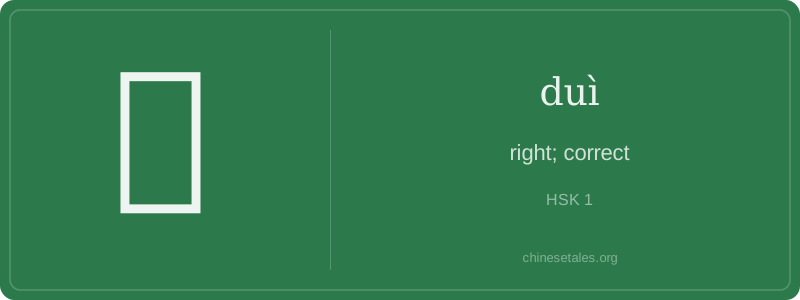
The earliest form of 对 (oracle bone script, ~1200 BCE) wasn’t abstract at all — it showed a hand holding a small, upright object (like a ritual token or tally stick) placed precisely opposite another identical object, both aligned on a base line. Over centuries, the dual objects simplified into two parallel strokes (the top two horizontal lines), the base became the radical 寸 (cùn — 'inch', symbolizing precise measurement), and the hand evolved into the left-side component (寸’s dot-and-hook shape). By the seal script era, the five-stroke structure was locked in: two horizontals (the matched pair), a vertical divider, and 寸 anchoring the bottom — a visual equation of balance.
This origin explains everything: 对 didn’t start meaning 'correct' — it meant 'to match face-to-face', 'to oppose in balanced symmetry', like two warriors bowing in formal combat or two officials presenting matching documents. In the *Analects*, Confucius uses 对 in contexts of proper response (e.g., replying appropriately to a ruler). Only later did 'matching' evolve into 'correct' — because in classical thought, truth *is* alignment: with ritual (lǐ), with virtue (dé), with reality itself. The character’s shape remains a silent reminder: correctness isn’t abstract — it’s measured, reciprocal, and grounded.
Think of 对 like the '✓' checkmark in a Western to-do list — not just 'right' as in morally correct, but 'aligned', 'matching', 'in agreement'. That’s its core vibe: two things fitting together perfectly, like puzzle pieces or a well-matched pair of chopsticks. In English, we say 'correct' and stop there; in Chinese, 对 carries an almost physical sense of correspondence — it’s why you say ‘duì duì’ (✓✓) to confirm something, or ‘duì le’ (✓ — done!) when a task is complete.
Grammatically, 对 is deceptively simple: it’s mostly used as an adjective meaning 'right/correct' (e.g., 'duì de'), or as a standalone interjection ('Duì!' = 'Yes! / Exactly!'). Crucially, it’s *not* used before nouns like English 'correct' — you wouldn’t say *duì shū* for 'correct book'; instead, you’d say *zhè běn shū duì* ('this book is right'). Learners often overuse it like English 'right' — but 对 rarely modifies nouns directly, and never means 'right' as in direction (that’s 右 yòu).
Culturally, 对 reflects a deep Chinese value: harmony through alignment — not just factual truth, but relational fit. Saying 'duì' signals shared understanding, not just intellectual agreement. A common mistake? Using 对 when you mean 'true' in philosophical contexts (use 真 zhēn instead) or confusing it with 是 (shì) — which asserts identity ('it *is* X'), while 对 affirms correctness or suitability ('X is *right*').