融
Character Story & Explanation
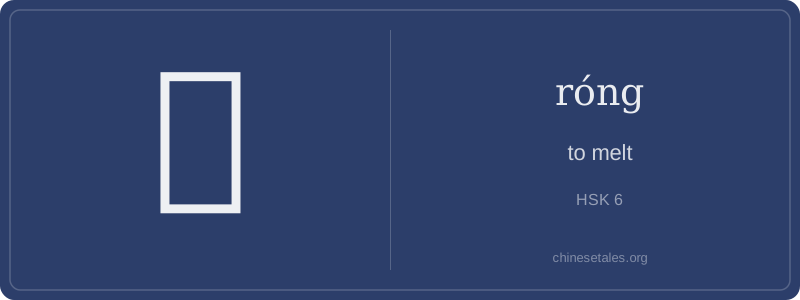
The earliest form of 融 appears on Warring States bamboo slips as a complex bronze script character: top half was 鬲 (lì), an ancient three-legged cooking vessel (like a ritual cauldron), and bottom half was 虫 (chóng), originally representing coiling steam or vapor rising from boiling liquid — not insects! Over centuries, the 虫 evolved into the modern 虫-like component (actually a stylized ‘insect’ radical repurposed for phonetic and semantic resonance), while the upper 鬲 remained remarkably stable — a rare case where the radical both looks and functions like its ancient self: heat + vessel = transformation via controlled heat.
This visual logic shaped its meaning: from physical melting in a cauldron (《说文解字》: '炊气上出也' — 'cooking vapors rising upward') to metaphorical 'blending' by the Han dynasty. In the *Zuo Zhuan*, 融 describes diplomatic reconciliation — states 'melting' hostility like wax near fire. By the Tang, poets like Li Bai used 融 to evoke unity with nature: 山光悦鸟性,潭影空人心 — where light and water 'fuse' perception and mind. Even today, the character’s structure whispers its origin: heat (鬲) applied to substance (虫-stroke complexity) yields seamless integration.
Think of 融 (róng) as Chinese ‘fusion’ — not just melting ice, but the elegant, almost alchemical blending of things that retain their essence while becoming something new: cultures merging, ideas interpenetrating, even financial systems integrating. Unlike English ‘melt’, which often implies loss of form (ice → water), 融 suggests harmonious transformation — like butter gently folding into a warm sauce, not disappearing but enriching it. It’s rarely used for literal melting (that’s usually 融化 huà or 溶解 róngjiě); instead, it’s the verb of choice for abstract integration: 融入 (róngrù, 'to integrate into'), 融合 (rónghé, 'to fuse/merge'), and 融会贯通 (rónghuì guāntōng, 'to synthesize knowledge fully').
Grammatically, 融 is almost always transitive and appears in compound verbs or set phrases — you’ll rarely see it alone in modern speech. Learners often mistakenly use it like ‘melt’ in simple sentences (e.g., *太阳融了雪*), but native speakers say 雪融化了 (xuě rónghuà le). Instead, 融 shines in abstract contexts: 两种文化相互融合 (liǎng zhǒng wénhuà xiānghù rónghé — 'two cultures mutually fuse') or 这个理论融汇了东西方思想 (zhège lǐlùn rónghuì le dōng xī fāng sīxiǎng — 'this theory synthesizes Eastern and Western thought').
Culturally, 融 carries Confucian resonance — harmony (和 hé) isn’t uniformity, but respectful blending, like tea leaves releasing flavor without losing identity. A common error? Overusing it where simpler verbs like 合 (hé, 'join') or 结合 (jiéhé, 'combine') fit better. Also, watch tone: róng (2nd) is never confused with rǒng (3rd, 'redundant') — mispronouncing it sounds like you’re calling someone ‘superfluous’ mid-sentence!