蚁
Character Story & Explanation
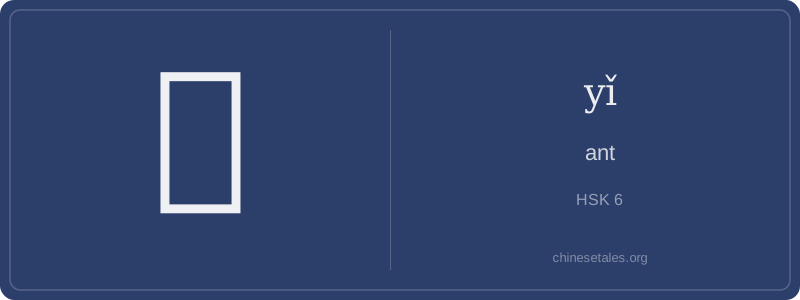
The earliest form of 蚁 appears in late Warring States bamboo texts — not as a pictograph of an ant (too small to depict clearly!), but as a phonosemantic compound: 虫 (insect radical) + 义 (yì, later simplified to 乂-like shape, then standardized as 义). The right side wasn’t originally ‘righteousness’ — it was a borrowed sound component, chosen because its ancient pronunciation rhymed closely with *ngəʔ (proto-Chinese for ‘ant’). Over centuries, the right-hand element evolved from a complex bronze-script form into the clean, angular 义 we see today — its strokes (丶、丿、一、丿、丶) now visually echo antennae and segmented body when you tilt your head.
By the Han dynasty, 蚁 had shed any literal insect depiction and fully embraced its semantic role within the 虫 family. Classical texts like the *Huainanzi* used 蚁 to symbolize insignificance paired with purpose: ‘A single ant cannot lift a grain, but ten thousand can move a mountain.’ Its visual simplicity — just nine strokes — belies deep philosophical weight: the ant isn’t weak; it’s the unit of collective force. Even today, when writers use 蚁 in phrases like 蚁附 (yǐ fù, ‘swarm like ants’), they’re invoking millennia of layered meaning — not entomology, but ethos.
Think of 蚁 (yǐ) as Chinese’s tiny but tenacious 'micro-manager' — not just a bug, but a cultural shorthand for relentless, collective effort. In English, we say 'ants at work'; in Chinese, 蚁 instantly evokes industriousness, fragility, and quiet power — often with poetic or ironic weight. Unlike English where 'ant' is neutral, 蚁 frequently appears in metaphorical compounds (like 蚁群 'ant colony') to suggest scale, vulnerability, or emergent intelligence — never just zoology.
Grammatically, 蚁 is almost never used alone in modern speech; it’s a bound morpheme. You won’t say *‘I saw an ant’* as ‘我看见一只蚁’ — that sounds archaic or literary. Instead, you’ll use compound nouns: 蚂蚁 (mǎ yǐ) for the everyday word, or technical terms like 白蚁 (bái yǐ, ‘termite’). Even in classical allusions — like Mencius comparing small virtue to ‘an ant’s strength’ — 蚁 always pairs with another character to ground its meaning.
Culturally, learners often mispronounce it as yí (second tone) due to influence from similar-sounding words like 已 (yǐ), or overextend it into standalone usage. Remember: 蚁 is a linguistic seed — potent, precise, and always needs company. Its real magic lives in compounds, where it adds humility, scale, or quiet resilience — like calling someone a ‘tiny ant’ (小蚁) not to belittle them, but to honor their unassuming persistence.