衷
Character Story & Explanation
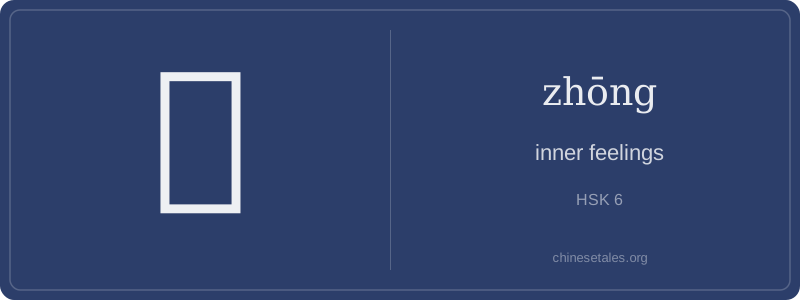
The earliest form of 衷 appears on Warring States bamboo slips as a stylized picture: a chest (represented by a curved line) wrapped tightly by cloth — literally ‘the inner garment’. Over time, this evolved into the seal script shape showing 衣 (clothing) as the outer frame, with 中 (zhōng, ‘center’) inside — not as a phonetic component, but as a semantic one: *the center beneath the clothes*. The modern character retains that elegant containment: the 衣 radical wraps around the 中, visually enacting the idea of ‘what lies deep within the body, hidden under attire’.
This physical origin grounded its meaning in embodied sincerity. In the *Zuo Zhuan* (c. 4th century BCE), 衷 describes genuine intent behind diplomatic words — ‘his words were 衷, though his actions concealed them’. By the Han dynasty, it had crystallized into the abstract noun we know today: the irreducible, unperformative core of feeling. Interestingly, its visual structure — clothing enclosing center — became a cultural metaphor: authenticity isn’t naked exposure; it’s what remains *within proper social covering*. That’s why 衷 never means ‘private’ or ‘secret’, but always ‘true’ and ‘deeply felt’.
At its heart, 衷 (zhōng) isn’t just ‘inner feelings’ — it’s the quiet, unvarnished truth that lives beneath polite speech and social performance. Think of it as the emotional core you’d confess to a lifelong friend at 2 a.m., not the cheerful ‘I’m fine!’ you say at dinner. It carries weight, sincerity, and often vulnerability — so using it casually (e.g., *‘I have some 衷 feelings about coffee’*) feels jarringly poetic or even theatrical in Chinese.
Grammatically, 衷 almost never stands alone. You’ll find it only in fixed, literary compounds like 由衷 (yóu zhōng, ‘from the bottom of one’s heart’) or 衷心 (zhōng xīn, ‘sincere, heartfelt’), where it modifies nouns or functions adverbially. Crucially, it’s *not* a verb — you don’t ‘zhōng’ something — and it’s never used predicatively (*‘He is 衷’* is ungrammatical). Learners sometimes overextend it like English ‘inner’, but in Chinese, inner *states* are expressed with 心 (xīn) or 情 (qíng); 衷 is reserved for *authenticity of feeling*, especially when contrasted with outward appearance.
Culturally, 衷 reflects Confucian values: sincerity (诚 chéng) must arise from the true self — not ritual, not duty, but the unmediated core. That’s why 衷 is common in formal speeches, letters of gratitude, or political declarations — always signaling moral gravity. A classic mistake? Confusing it with 中 (zhōng, ‘middle’) due to identical pinyin — but while 中 is spatial or neutral, 衷 is deeply personal and affective. Its radical 衣 (clothing) hints at the ancient idea: what’s *under your clothes* is what’s truly you.