裳
Character Story & Explanation
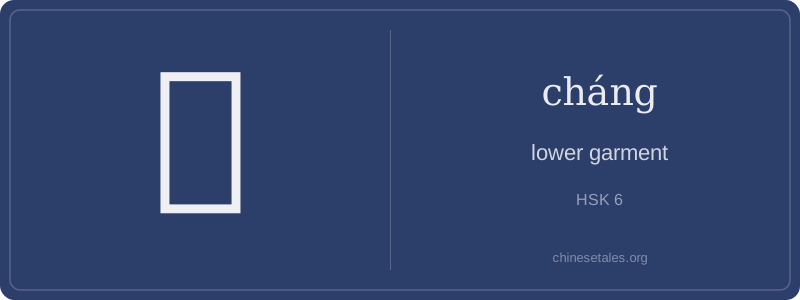
The earliest form of 裳 appears in bronze inscriptions as two parallel vertical lines flanked by wavy or zigzag patterns — a stylized depiction of a draped, pleated skirt hanging from a waistband. Over time, the top evolved into the 衣 radical (showing the garment’s category), while the bottom solidified into 尚: not just 'high', but 'held up with reverence'. By the seal script era, the 14 strokes were locked in — eight for 衣 (including the dot and hook that mimic folded fabric), six for 尚 (with its distinctive 'small' + 'upward stroke' structure). Even today, trace the flow: your pen starts at the collar (top of 衣), flows downward like cloth falling, then finishes with the dignified upward lift of 尚 — mirroring how the garment itself was worn: anchored, flowing, honored.
This visual logic mirrors its semantic journey. In the Book of Songs (Shījīng), 裳 appears in lines like '我衣之裳' ('I wear my upper and lower garments'), establishing its role as the essential counterpart to 衣. Later, in Bai Juyi’s Ní Cháng Yǔyī Qū ('Rainbow Skirt Feather Jacket Dance'), it became synonymous with ethereal beauty — not mere fabric, but a symbol of transcendence. The character’s very shape preserves that duality: the grounded 衣 (earthly function) meeting the aspirational 尚 (celestial grace). To write 裳 is to reenact the ritual act of draping dignity onto the body.
Think of 裳 (cháng) not as 'clothes' in general, but as the ancient Chinese equivalent of a ceremonial skirt — long, layered, and deeply symbolic. It’s not everyday wear; it’s what poets wore when composing odes by moonlight, what officials donned for ancestral rites, and what women in classical literature swirled dramatically while reciting farewell verses. Its core feeling is elegance, formality, and vertical grace — notice how the character literally hangs down: the 衣 (yī, 'clothing') radical forms the top 'collar', while the bottom 尚 (shàng, 'esteem, high') suggests something elevated *in status*, not height — like clothing worthy of reverence.
Grammatically, 裳 almost never appears alone in modern speech — it’s fossilized in literary compounds or poetic phrases. You’ll hear it in fixed expressions like 衣裳 (yī shang), where it pairs with 衣 to mean 'clothing' as a whole — but crucially, here 裳 is pronounced shang (neutral tone), *not* cháng! That’s the #1 trap: learners see 裳 and default to cháng, but in 衣裳 it’s a lexicalized variant. In classical texts or formal writing, though, cháng stays strong — e.g., '霓裳' (ní cháng, 'rainbow skirt'), evoking celestial dancers in Tang poetry.
Culturally, 裳 anchors us to pre-Qin dress codes: men and women both wore it — a wraparound lower garment, often knee- or ankle-length, tied at the waist. Unlike modern trousers (褲 kù), it carried ritual weight: Confucius himself criticized those who wore mismatched or improperly draped 裳. Today, mistaking it for casual 'pants' or overusing cháng outside literary contexts sounds jarringly archaic — like quoting Shakespeare to order coffee. Respect its elegance, and use it only where poetry, history, or solemnity demands.