诵
Character Story & Explanation
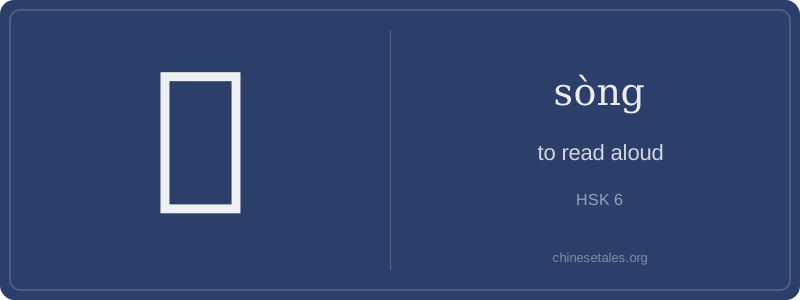
The earliest form of 诵 appears in bronze inscriptions as a combination of 言 (speech) and 甬 (a phonetic component, also meaning ‘passage’ or ‘pipe’ — evoking sound flowing through a channel). Though no oracle bone version survives, the seal script shows 言 on the left and 甬 on the right, with 甬’s top stroke curving like a stylized mouth exhaling. Over time, 言 simplified to 讠 (the ‘speech’ radical), and 甬 lost its bottom horizontal stroke, becoming the modern 又 + 用 shape — but crucially, the ‘flowing sound’ idea remained embedded in its phonetic core.
By the Warring States period, 诵 was already used in texts like the *Zuo Zhuan* to describe ritual recitation of odes and ancestral hymns. Its visual logic is elegant: the speech radical (讠) signals language, while 甬 — pronounced sòng and meaning ‘pipe,’ ‘channel,’ or ‘vessel’ — suggests sound channeled deliberately, like water through a conduit. This dual emphasis on *intentional articulation* and *sonic transmission* explains why 诵 never meant silent reading or casual speaking — it was born in temples and academies, where breath, pitch, and rhythm transformed text into embodied knowledge.
At its heart, 诵 isn’t just ‘reading aloud’ — it’s ritualized vocal embodiment: the act of committing words to memory *through* the voice, not just the eyes. In Chinese tradition, recitation is how wisdom enters the body — Confucius praised disciples who could 诵《诗》 (recite the Odes) fluently, because fluency signaled internalization, not rote repetition. You’ll rarely see 诵 with a direct object like ‘a book’; it almost always takes classical texts, poems, or sutras — think 诵经 (chant scriptures), 诵诗 (recite poetry), or 诵读 (a formal compound meaning ‘oral reading’).
Grammatically, 诵 is nearly always transitive and requires a clear, weighty object — you don’t 诵 a grocery list. It often appears in literary or ceremonial contexts: passive constructions (被诵读), serial verbs (吟诵, 朗诵), or as a verb in formal writing. Learners mistakenly use it for casual reading aloud (e.g., ‘I’ll read this email out loud’); that’s 读出来 or 大声读. 诵 implies reverence, training, or performance — it’s what monks do at dawn, students do before exams, and actors rehearse monologues.
Culturally, 诵 reveals how deeply Chinese values link voice, memory, and moral cultivation. The sound of the voice shapes the mind — hence the ancient pedagogical method of ‘learning by chanting.’ A common error? Overusing 诵 in spoken Mandarin; native speakers prefer 读 or 念 in daily talk. Reserve 诵 for moments where the *act of voicing* carries intention — memorization, homage, or discipline. It’s not about volume — it’s about resonance.