诽
Character Story & Explanation
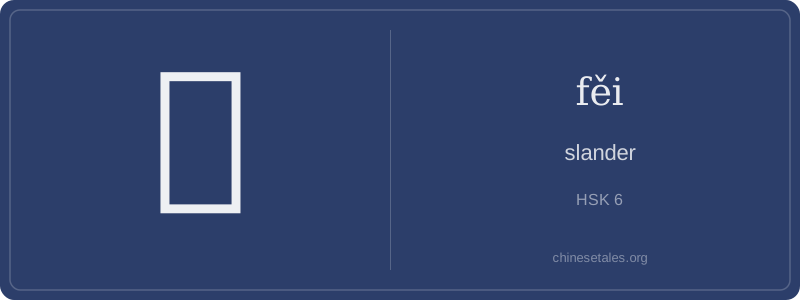
The earliest form of 诽 appears in Warring States bamboo slips as a compound: left side was 言 (yán, ‘speech’), right side was 匪 (fěi, ‘not’, ‘bandit’ — originally a bent rope binding captives, later abstracted to mean ‘illegitimate’). In seal script, the right side already showed its distinctive ‘square + bent stroke’ shape — evoking something twisted, concealed, and unlawful. By the Han dynasty clerical script, the left became 讠 (the simplified speech radical), and the right solidified into today’s 匪: ten strokes total — four for 讠, six for 匪 — each stroke reinforcing the idea of speech gone rogue.
This visual logic shaped its meaning: ‘speech that is not truthful — speech that binds like a bandit’. The Shuōwén Jiězì (121 CE) defines it as ‘以言毁人’ (yǐ yán huǐ rén) — ‘to destroy a person with words’. In the Mencius, Confucian scholars warn against ‘好诽’ (hào fěi — ‘fondness for slander’), linking it to moral failure. Even today, the character’s structure whispers its warning: if your words look like they’re hiding something (匪), and come from the mouth (讠), tread carefully — you may be crossing into 诽.
Imagine a bustling Ming-dynasty tea house where a scholar, furious over a rival’s promotion, whispers venomous half-truths about his colleague’s ‘corrupt dealings’ — not with evidence, but with sneering intonation and knowing glances. That whispered, underhanded, reputation-eroding act? That’s 诽 (fěi). It’s not just ‘slander’ in the legal sense; it’s the deliberate, malicious twisting of words to wound someone’s social standing — sharp, personal, and dripping with intent. Unlike neutral ‘criticism’ (批评 pīpíng), 诽 always implies falsehood and malice.
Grammatically, 诽 is almost never used alone. You’ll see it bound tightly in compounds like 诽谤 (fěibàng) or as the verb in formal constructions: ‘被诽谤’ (bèi fěibàng — ‘to be slandered’) or ‘恶意诽谤’ (èyì fěibàng — ‘malicious slander’). Learners often mistakenly use it like English ‘slander’ as a standalone noun or verb — but you’d never say *‘他诽了我’; instead, it’s *‘他诽谤我’* or *‘他对我进行诽谤’*. It’s a heavy, formal word — rare in casual speech, common in courtrooms, news reports, and classical essays.
Culturally, 诽 carries Confucian gravity: damaging someone’s name isn’t just rude — it disrupts social harmony (和 hé) and violates the virtue of integrity (信 xìn). A classic pitfall? Confusing it with 谤 (bàng), which can be milder or even justified criticism (e.g., ‘谏谤’ — remonstrance). But 诽? No ambiguity — it’s always false, always harmful, always ethically condemned.