赁
Character Story & Explanation
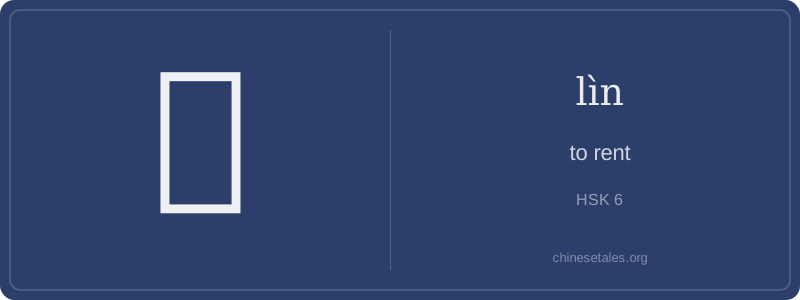
The earliest form of 赁 appears in bronze inscriptions as a compound: left side 貝 (bèi, ‘cowrie shell’, symbolizing value/money), right side 任 (rèn, ‘to shoulder responsibility’). Visually, it showed a shell beside a person bearing a load — not physical cargo, but the *burden of obligation*. Over centuries, 任 simplified: its top stroke became (a hand gesture), its bottom evolved into the modern 任 shape, while 貝 retained its distinctive ‘shell-and-line’ structure. By the Han dynasty, the two components fused into today’s 10-stroke form: 贝 on the left, 任 on the right — a perfect visual contract: money + duty.
This duality shaped its meaning from day one: in the *Zuo Zhuan*, 赁 appears in records of feudal lords ‘leasing’ military service from vassals — payment exchanged for sworn duty. Later, in Tang legal codes, 赁 distinguished commercial leases from gift-based use (借) or permanent sale (卖). Even today, the character’s shape whispers its origin: every time you write those 10 strokes, you’re tracing a 2,500-year-old handshake sealed with shells and solemn promise.
At its core, 赁 (lìn) isn’t just ‘to rent’ — it’s the quiet hum of transactional trust: handing over money for temporary access to something valuable. The character radiates a sense of *conditional possession*, not ownership — think leasing an office space, chartering a yacht, or even renting historical legitimacy (yes, in classical texts, rulers ‘rented’ Heaven’s Mandate!). Its meaning feels weightier and more formal than 租 (zū), which covers everyday renting; 赁 leans into legal, contractual, or high-stakes contexts.
Grammatically, 赁 is almost always transitive and verb-only — you won’t find it as a noun like ‘rent’ in English. It rarely stands alone; instead, it appears in compounds (e.g., 赁用车辆, 赁房) or with aspect particles: 他已赁下整层楼 (tā yǐ lìn xià zhěng céng lóu — 'He has already leased the entire floor'). Learners often mistakenly use it like 租 in casual speech ('I rented a bike'), but native speakers would say 我租了辆自行车 — using 赁 here sounds stiff, bureaucratic, or even archaic.
Culturally, 赁 carries faint echoes of pre-modern contract law: in Ming-Qing legal documents, 赁 specifically implied written agreements with defined duration and penalty clauses. That legacy survives today — if a contract says 赁期 (lìn qī), it’s not just ‘rental period’ but a legally binding term. A common mistake? Overusing it in spoken Mandarin or confusing it with 借 (jiè, 'to borrow') — 赁 always involves payment; 借 does not.