赤
Character Story & Explanation
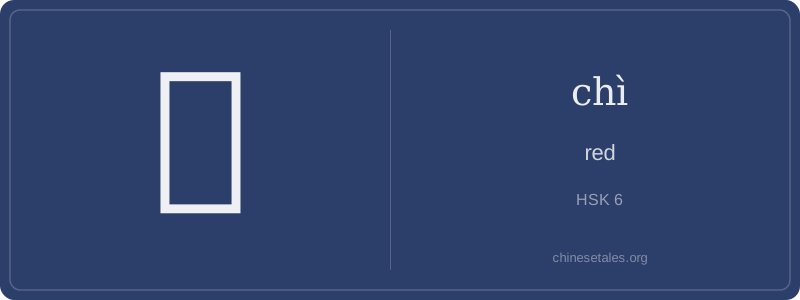
The earliest form of 赤 appears in oracle bone inscriptions as a stylized human figure with arms raised and legs apart — a pictograph of a *naked person*. The top part (⺈) evolved from a head/hair motif, while the lower part (土) originally represented bent legs and feet, later simplifying into the modern 'earth' radical — not because it means 'earth', but because its shape stabilized that way. Over centuries, the figure became more abstract: the upper strokes sharpened into (a variant of 厂), and the lower component fused into 土, giving us today’s 7-stroke structure — still echoing bareness, exposure, and vividness.
This nakedness metaphor birthed its core meanings: first 'bare, exposed' (as in 赤身, chì shēn — 'bare body'), then by color association — bare skin is flushed red, blushing red, blood-red — hence 'red'. By the Warring States period, it was firmly semanticized as red in texts like the *Zuo Zhuan*, where 赤狄 ('Red Di') named a nomadic tribe possibly distinguished by red-dyed garments or banners. The visual logic holds: just as nudity reveals truth, 赤 reveals essence — unfiltered, unmasked, elemental.
Imagine you’re standing in front of a Ming-dynasty imperial palace gate — not the usual vermilion red, but a deep, almost glowing *chì* red, so intense it seems to pulse with heat and authority. That’s 赤: not just any red, but *unadulterated*, *primal* red — raw, exposed, unvarnished. It carries emotional weight: embarrassment (赤脸), vulnerability (赤子之心), or danger (赤地千里). Unlike the neutral 红 (hóng), which you’d use for a red apple or traffic light, 赤 appears in literary, historical, or emotionally charged contexts — think ‘red-faced shame’ or ‘red earth famine’.
Grammatically, 赤 functions as both adjective and noun. As an adjective, it’s often pre-nominal and formal: 赤字 (chì zì, 'deficit') or 赤手 (chì shǒu, 'bare-handed'). It rarely takes degree adverbs like 很 — you wouldn’t say *很赤*; instead, it’s used starkly or compoundingly (e.g., 赤裸裸, chì luǒ luǒ, 'nakedly blatant'). Learners mistakenly substitute it for 红 in everyday speech — saying *赤苹果* sounds like you’re quoting a Song dynasty poet describing a forbidden fruit, not buying groceries.
Culturally, 赤 evokes ancient cosmology (one of the Five Colors linked to the south and fire) and revolutionary symbolism (e.g., 赤卫队, 'Red Guards'), but also purity — the *chì zǐ zhī xīn* ('red-child heart') is the Confucian ideal of innocent sincerity. Watch out: in idioms like 赤地千里, 赤 means 'barren', not 'red' — a semantic twist rooted in drought-scorched, reddish soil. This polysemy is why HSK 6 demands context mastery, not just vocabulary lists.