赴
Character Story & Explanation
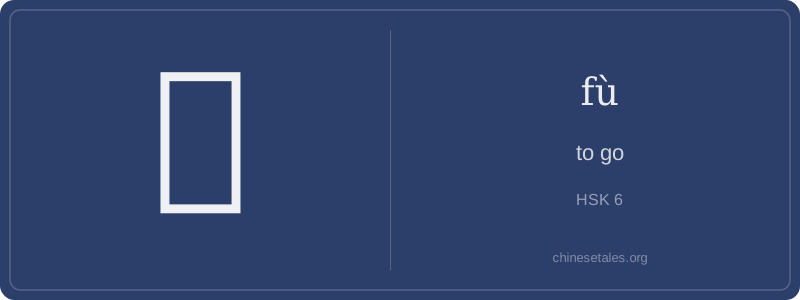
The earliest form of 赴 appears in bronze inscriptions around 1000 BCE: a walking person (the precursor to 走) combined with 卜 (bǔ), a divination crack on a turtle shell — symbolizing a fateful, divinely sanctioned journey. Over centuries, 卜 evolved into 夫 (fū), a man carrying responsibility (as in 夫人, 'gentleman's wife'), and the walking radical 走 solidified at the bottom. By the Han dynasty, the character had stabilized into its current shape: the top 夫 (9 strokes total, counting the walk radical’s 7 + 夫’s 2) visually anchoring the idea of a person stepping forward with resolve.
This evolution mirrors its semantic journey: from ritual pilgrimage guided by oracle bones, to military dispatches in the *Zuo Zhuan* ('He 赴 the border to defend the state'), to Tang poetry where poets 赴 mountains seeking enlightenment. Even today, the visual rhythm of 赴 — a man (夫) striding forward (走) — whispers urgency and moral weight. It’s no accident that in Chinese opera, actors take a sharp, deliberate step when portraying a general who ‘fù battle’ — the character lives in the body before it lives on the page.
At first glance, 赴 (fù) means 'to go' — but not just any go. It’s the kind of going that carries weight: a deliberate, often formal or solemn movement toward a commitment — a meeting, an appointment, a battlefield, or even death. Think 'answer the call', 'respond to duty', or 'fulfill an obligation'. Unlike 去 (qù), which is neutral and everyday ('I’m going to the store'), 赴 implies intentionality, gravity, and social resonance. You don’t 赴 a coffee date — unless it’s with your future in-laws.
Grammatically, 赴 is almost always transitive and requires an object — you 赴 *something*: a meeting (赴会), a banquet (赴宴), an exam (赴考). It rarely stands alone and never takes aspect particles like 了 or 过 directly after it (*赴了 is ungrammatical); instead, you’d say 赴了约 (fù le yuē) — where the aspect marker attaches to the object noun. Learners often overuse it trying to sound formal, but native speakers reserve it for contexts where purpose, responsibility, or consequence is foregrounded.
Culturally, 赴 reflects a deep-rooted Confucian value: action as response — to duty, to hierarchy, to promise. In classical texts, 赴 appears in phrases like 赴死 (fù sǐ, 'go to one’s death') — not passively dying, but actively walking toward fate. Modern usage still echoes this: 赴美 (fù měi, 'go to the U.S.') sounds official, perhaps for study or work; while 去美国 is just casual travel. A common mistake? Using 赴 where 去 or 到 would be natural — making your sentence sound oddly ceremonial, like showing up to a picnic in full diplomatic regalia.