跪
Character Story & Explanation
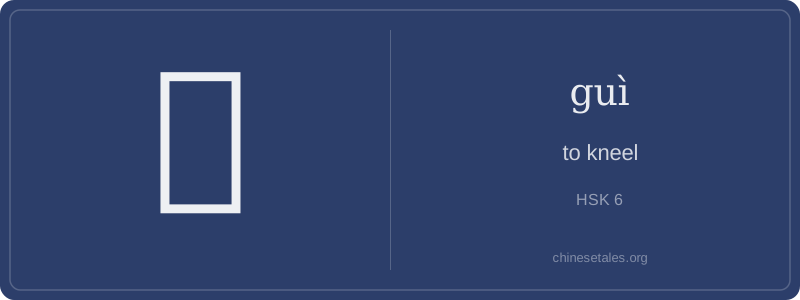
The earliest form of 跪 appears in Western Zhou bronze inscriptions as a vivid pictograph: a human figure (人) shown frontally, with bent legs and feet (足) clearly planted downward — no arms, just focused gravity. Over centuries, the ‘person’ element simplified into the top component (a variant of 卑, meaning ‘humble’), while the radical 足 (foot/leg) anchored the bottom. By the seal script era, the two parts fused: the upper part stylized into the current 卑-like shape (with the crucial horizontal stroke across the ‘mouth’ representing bowed head), and the lower 足 kept its distinctive four-dot ‘feet’ (⻊). Thirteen strokes total — every one evokes pressure, descent, and grounded humility.
This visual logic shaped its meaning: from literal posture to symbolic deference. In the Book of Rites (礼记), kneeling distinguished proper mourning rituals from mere weeping. Mencius noted that even thieves would ‘not dare 跪 before the altar’ — showing how deeply moral weight was baked in. Interestingly, the character’s structure mirrors its function: the upper ‘humble’ component presses down onto the lower ‘feet’ radical, literally illustrating submission through composition.
Imagine a solemn moment in an old Beijing courtyard: a young scholar, sleeves brushing the stone floor, lowers himself slowly — not just bending, but placing both knees firmly on the ground, back straight, hands folded. That precise, deliberate act is 跪 (guì). It’s not casual sitting or bowing; it’s full-body submission, reverence, or desperate pleading. Unlike English ‘kneel’, which can be neutral (e.g., ‘kneel to tie your shoe’), 跪 carries heavy emotional and social weight — you 跪 before elders, ancestors, or in apology so profound it verges on self-erasure.
Grammatically, 跪 is a verb that usually appears in simple transitive or intransitive clauses — often with directional complements (跪下 guì xià, ‘kneel down’) or aspect particles (跪着 guì zhe, ‘kneeling [while doing something]’). Learners mistakenly use it for everyday kneeling (e.g., gardening); native speakers reserve it for ritual, humiliation, or high-stakes emotion. You’d never say ‘我跪着拔草’ — that’s 蹲 (dūn) or 趴 (pā). Also, note: 跪 is rarely used in the perfective aspect without context — ‘他跪了’ sounds incomplete unless followed by why or for how long.
Culturally, this character echoes Confucian hierarchy: kneeling was codified in rites like the Three Kowtows (三跪九叩), where each kneel marked escalating respect. Today, it’s still visceral — a politician 跪 on TV to beg forgiveness goes viral instantly. Misusing it risks sounding melodramatic or archaic. And beware the tone: guì (4th) ≠ guī (1st, ‘tortoise’) — mispronouncing it invites awkward silence or giggles.