轨
Character Story & Explanation
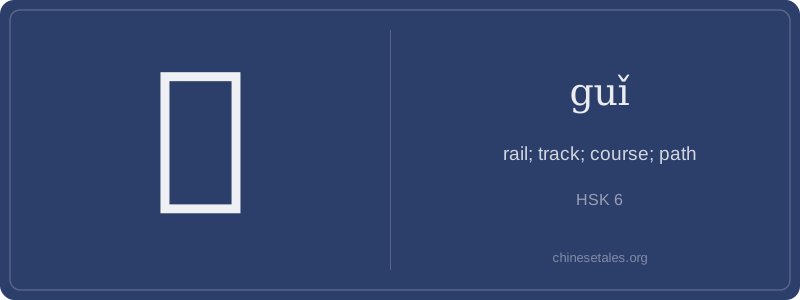
The earliest form of 轨 appears in bronze inscriptions as two parallel horizontal lines (representing ruts) beneath a simplified chariot 車 (later reduced to 车). Over time, the top part evolved: the ancient 軌 had a ‘measuring tool’ component (a ruler-like glyph) beside the wheel — emphasizing precision. By seal script, this became the now-familiar 只 (zhǐ) on the right: not ‘only’, but a stylized depiction of a calibrated gauge used to ensure axle width matched road ruts. Stroke by stroke, the modern six-stroke 轨 emerged: 车 (4 strokes) + 只 (2 strokes), visually encoding ‘vehicle + measurement’. No accident — it was literally about standardizing wheel spacing so chariots wouldn’t derail on imperial highways.
This obsession with calibrated alignment bled into philosophy: Confucius praised rulers who ‘set the rail for virtue’ (立轨于德), meaning they established clear, replicable moral standards. In the Book of Rites, 轨 appears in passages about ritual propriety — where correct behavior is as non-negotiable as staying within wheel ruts. Even today, the character’s visual structure whispers its origin: the left side moves (车), the right side measures (只), and together they demand conformity to an external standard — whether on a railway, in governance, or in self-cultivation.
Imagine standing on a deserted high-speed rail platform at dawn — not a train in sight, but two gleaming steel rails stretching into the mist. That’s 轨 (guǐ) in action: not just metal, but *the physical and metaphysical groove* that guides motion, order, and consequence. In Chinese, 轨 isn’t neutral like ‘rail’ in English — it carries weight: a rail implies direction, constraint, and expectation. You don’t ‘have a rail’; you ‘follow a rail’ (遵循轨道), ‘deviate from the rail’ (脱离轨道), or ‘establish a new rail’ (确立新轨道) for policy or behavior.
Grammatically, 轨 almost never stands alone. It’s a bound morpheme — you’ll see it only in compounds like 轨道 (guǐdào, ‘track/orbit’) or 轨范 (guǐfàn, ‘model/standard’). Learners often mistakenly use it as a verb (e.g., *‘guǐ le’*) — but no! It’s never conjugated. And while ‘rail’ feels industrial in English, 轨 can be deeply abstract: a person’s life 轨迹 (guǐjì, ‘trajectory’) isn’t plotted on a map — it’s etched by choices, education, and social forces.
Culturally, 轨 echoes ancient China’s obsession with alignment — think of chariot wheels rolling in precise ruts on imperial roads (hence its 车 radical). Today, ‘going off-rail’ (脱轨) is a common metaphor for moral collapse or systemic failure — used in headlines about finance, politics, even AI ethics. The biggest trap? Assuming 轨 = ‘track’ in all contexts: ‘music track’ is 曲目, not *音乐轨. Always pair it with dào, jì, fàn, or lù — never treat it like a standalone noun.