辉
Character Story & Explanation
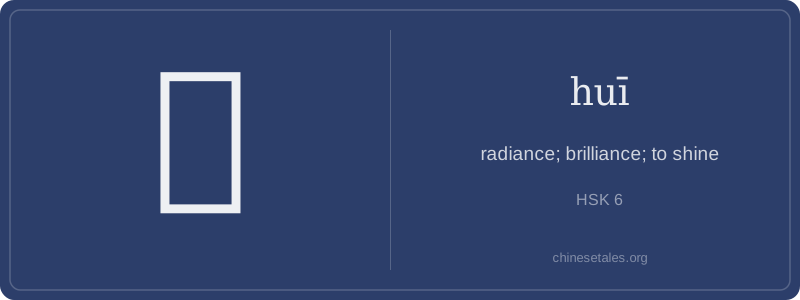
The earliest form of 辉 appears in bronze inscriptions (c. 1000 BCE) as a composite: a sun-like circle (later simplified to ⺌, the ‘sun’ radical) above a phonetic component that looked like 巾 (jīn, cloth) — but actually represented *huī* as a sound clue. Over centuries, the sun radical stabilized at the top, while the lower part evolved from a stylized ‘fire + cloth’ shape into the modern 奚 (xī), now purely phonetic. Crucially, the original pictograph wasn’t just ‘sun’ — it depicted *sunlight striking a ceremonial bronze vessel*, whose reflective surface glowed with sacred authority — hence the core sense of ‘lustrous prestige’, not generic light.
This ritual origin explains why 辉 never meant ‘flash’ or ‘glare’ — it was the controlled, dignified gleam of ancestral bronzes in temple light. By the Han dynasty, it appeared in the *Shuōwén Jiězì* dictionary defined as ‘light that shines forth with beauty and reverence’. Poets like Li Bai used it metaphorically: ‘星辉’ (xīng huī — star-radiance) implied celestial blessing, not astronomy. Even today, when we say 一生光辉 (yī shēng guāng huī — 'a life of radiance'), we’re invoking that ancient link between moral stature and visible luster — a glow earned, not emitted.
At its heart, 辉 isn’t just ‘light’ — it’s *luminous presence*: the kind of brilliance that carries weight, dignity, and resonance. Think of sunlight catching polished bronze, or a leader’s charisma shimmering in a crowd — this is 辉, not mere brightness but *radiant significance*. It evokes warmth, honor, and enduring impact, rarely used for literal flashlights or LEDs (that’s 光 or 亮), but for glory, legacy, and poetic illumination.
Grammatically, 辉 is almost always a noun or verb in formal, literary, or compound contexts — you’ll rarely see it stand alone as a predicate verb like ‘it shines’. Instead, it appears in compounds (光辉, 辉煌) or as the verb in elegant constructions: 闪耀着光辉 (shǎn yào zhe guāng huī — 'shines with radiance') or 为…增辉 (wèi…zēng huī — 'to add luster to…'). A classic mistake? Using 辉 where 亮 or 明 would sound natural in speech — e.g., saying *这个灯很辉* instead of *这个灯很亮*. That sentence doesn’t just sound odd — it sounds like you’re describing a lamp as if it were a national hero.
Culturally, 辉 carries quiet Confucian gravitas — it’s the light of virtue, the brilliance of moral clarity. In classical texts, it often pairs with 德 (virtue): 德辉 (dé huī — 'the radiance of virtue'), suggesting inner luminosity made visible. Learners also overlook its tonal nuance: huī is first tone — flat and bright, mirroring its meaning — so mispronouncing it as huǐ (third tone) accidentally invokes 'destroy' (毁), a hilarious (and awkward) mix-up when praising someone’s achievements!