辐
Character Story & Explanation
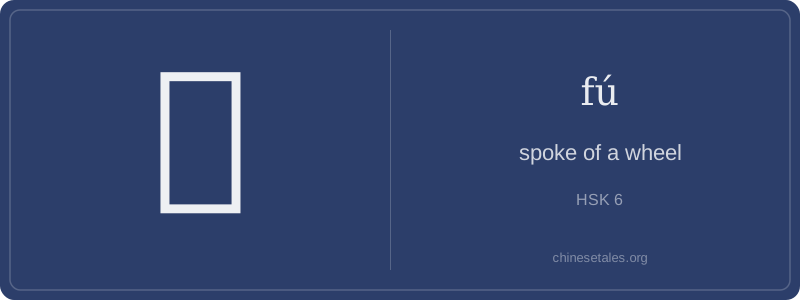
The earliest form of 辐 appears in Warring States bamboo slips and small-seal script: a left-side 车 (chariot) radical, and a right side that originally depicted *two parallel lines* (representing straight, rigid rods) intersected by a *crossbar* — visually echoing how spokes connect hub to rim at precise angles. Over time, the right side evolved from 甫 (a phonetic component meaning ‘beginning’ or ‘foundation’) — chosen for sound, not meaning — but the visual logic held: the horizontal strokes evoke the cross-section of a spoke, while the vertical stroke anchors it like a shaft. Stroke order reinforces structure: first the cart frame (车), then the precise geometry of the spoke (甫’s components: horizontal, vertical, then enclosing strokes).
In the Book of Rites (Lǐjì), chariots were symbols of cosmic order — the hub represented the ruler, the rim the people, and the 辐 the loyal ministers connecting them. Mencius even used ‘辐凑’ (spokes converging) as a metaphor for talent gathering around virtue. This radial logic later birthed ‘辐射’ — where ‘spoke-like’ emission became the perfect image for energy spreading outward from a source. So 辐 didn’t just describe wheels; it encoded an ancient worldview: influence must be structured, centered, and evenly distributed — just like spokes.
Picture a chariot wheel spinning across the ancient Central Plains — not just any part, but the slender, radiating rods that brace the rim to the hub: that’s 辐 (fú). This character isn’t abstract; it’s tactile engineering. In classical Chinese, 辐 appears in technical descriptions of vehicles and metaphors for centrality and influence — like spokes converging on a hub, power flows *from* the center *outward*. Modern usage is rare in daily speech but vital in literary, historical, and technical contexts (e.g., ‘辐射’ — literally ‘spoke-radiation’ — now means ‘radiation’, borrowing the radial imagery).
Grammatically, 辐 functions almost exclusively as a noun, often in compound words or classical set phrases. You won’t say ‘this wheel has eight 辐’ in casual Mandarin — instead, you’ll encounter it in compounds like 辐射 or in historical texts describing chariot construction. Learners sometimes mistakenly use it as a verb (‘to radiate’) or confuse it with homophones like ‘福’ (blessing), but 辐 never stands alone as a verb or adjective — it’s a structural noun, anchored by its radical 车 (vehicle). Its presence signals precision, antiquity, or scientific metaphor.
Culturally, 辐 carries quiet authority: it’s the unseen backbone that makes movement possible. A common mistake is overgeneralizing its meaning — ‘辐’ doesn’t mean ‘ray’ or ‘beam’ by itself; only in compounds like 辐射 does it acquire that extended sense. Also, note its tone: fú (second tone), *not* fū or fǔ — mispronouncing it risks confusion with ‘伏’ (to crouch) or ‘府’ (government office). Remember: this is the spoke — slim, strong, and strictly radial.