舆
Character Story & Explanation
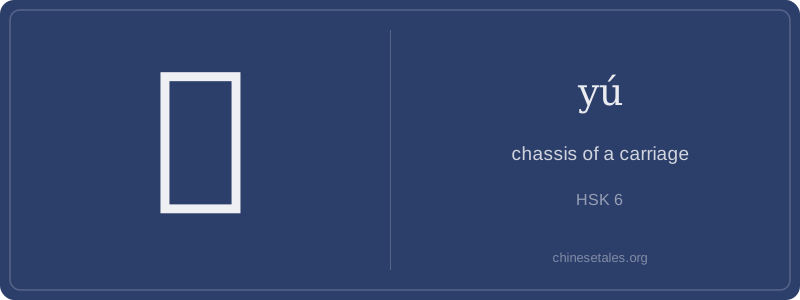
The earliest form of 舆 appears on late Shang oracle bones and Western Zhou bronzes as a vivid pictograph: a simplified cart body — two parallel horizontal lines (representing floorboards) connected by vertical strokes (side rails), all resting atop the 车 radical, which at the time looked like a stylized axle with two wheels. Over centuries, the top part evolved from a realistic platform into the modern upper component — 与 — which phonetically suggests pronunciation (yú) while retaining structural logic: the 'platform' (two horizontal strokes) is held up by 'support' (the crossed strokes beneath).
This visual logic became semantic truth: by the Warring States period, 舆 was standard terminology in military treatises like Sun Tzu’s *Art of War* (e.g., '舆重则动迟' — 'if the carriage chassis is heavy, movement is slow'), emphasizing load-bearing function. Later, in Sima Qian’s *Records of the Grand Historian*, 舆 subtly shifted from physical object to social metaphor — 'the people are the chassis upon which the ruler rides', foreshadowing its modern role in words like 舆论. The character didn’t just describe carts; it helped build the vocabulary of collective voice.
At its heart, 舆 (yú) is a beautifully archaic word for the *chassis* or *body* of a horse-drawn carriage — not the wheels, not the horses, but the wooden platform people sat on. Think of it as the 'passenger compartment' of ancient China’s luxury sedan chairs and war chariots. Though rarely used alone today, it survives with quiet authority in formal compounds like 舆论 (yú lùn, 'public opinion') — where 舆 metaphorically becomes 'the people carried', and 论 is 'discussion'. That’s key: 舆 implies collective movement, shared space, and social weight.
Grammatically, 舆 almost never stands solo outside classical texts or poetic allusions. You’ll see it only in set phrases (e.g., 舆情, 舆地), always as the first character in two-syllable nouns. Learners sometimes misread it as 'car' or 'vehicle' — but that’s 车 (chē) or 汽车 (qì chē). 舆 is strictly *what’s carried*, not what carries. Its tone (second tone yú) rhymes with 'you' — helpful, because this character is literally about *carrying people*, i.e., 'you' and everyone else.
Culturally, 舆 hides a subtle power shift: in early Zhou dynasty bronze inscriptions, it signified elite mobility and ritual status; by the Han, it quietly evolved into a symbol of the populace — hence 舆论 meaning 'opinion of the people carried together'. A common mistake? Confusing it with 易 (yì, 'easy') or 与 (yǔ, 'and') due to similar shape or sound — but those have no 'cart' radical! Remember: if you see 车 on the left, you’re dealing with transport infrastructure — not transportation itself.