辙
Character Story & Explanation
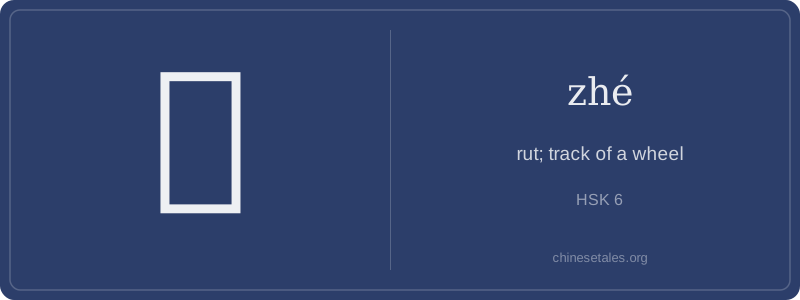
The earliest form of 辙 appears in bronze inscriptions of the Zhou dynasty (c. 1046–256 BCE) as a compound pictograph: a simplified 车 (chē, ‘cart’) above two parallel horizontal lines — unmistakably the twin grooves carved by wheels into clay or packed soil. Over centuries, the cart evolved from a detailed four-wheeled vehicle into the standardized 车 radical, while the ‘tracks’ became the right-hand component 徹 (chè, originally meaning ‘to penetrate thoroughly’ — later borrowed for sound). By the Han dynasty, the character stabilized into today’s 16-stroke form: 车 + 彻 — visually, a cart whose wheels have *thoroughly* scored the ground.
This visual logic shaped its semantic journey: from concrete wheel-ruts (Zuo Zhuan, 5th c. BCE: ‘车辙深三寸’ — ‘cart ruts three inches deep’) to metaphorical paths of behavior or thought. In Tang poetry, Du Fu used 辙 to evoke exile — ‘孤舟一系故园心,车辙已断音书绝’ — where broken ruts symbolize severed connections. The character’s endurance lies in that duality: grounded in dirt and physics, yet soaring into philosophy. Even today, when we say ‘不入俗辙’, we’re invoking over two millennia of cart-wheels turning, and warning against mindless repetition.
At its core, 辙 (zhé) is a vivid, tactile word — it’s not just any groove, but the deep, parallel furrows left by cartwheels on packed earth: literal ruts in the road. That physicality matters: it evokes inevitability, repetition, and sometimes stagnation — think of ‘falling into a rut’ in English, but with heavier historical baggage. Unlike abstract synonyms like 规律 (guīlǜ, ‘rule’) or 模式 (mōshì, ‘pattern’), 辙 carries weight, wear, and time.
Grammatically, 辙 is almost always noun-only — you’ll rarely see it as a verb or adjective. It appears most often in set phrases: 重蹈覆辙 (chóng dǎo fù zhé, ‘to repeat a past mistake’), or in literary/metaphorical contexts like ‘另辟蹊径,不循旧辙’ (‘blaze a new trail, not follow the old rut’). Learners sometimes mistakenly use it where 轨迹 (guǐjì, ‘trajectory’) or 路线 (lùxiàn, ‘route’) would fit better — but 辙 implies *repetition*, not just path. Also, note: it’s never used for modern car tire marks — that’s 轮胎印 (lúntāi yìn); 辙 belongs to the age of ox carts and imperial roads.
Culturally, 辙 is deeply tied to classical warnings about history repeating itself — Confucius himself lamented how rulers ignored ‘the ruts of ruin’. Today, it’s common in political essays and editorial writing, often with moral gravity. A frequent error? Overusing it in casual speech; no one says ‘我的工作太有辙了’ — it sounds archaic or ironic. Reserve it for moments of reflection, critique, or poetic contrast.