轰
Character Story & Explanation
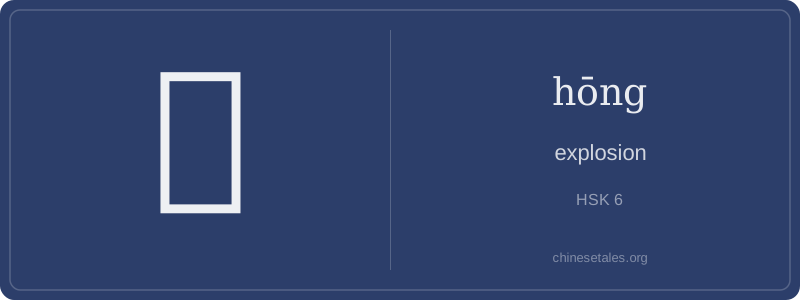
The earliest form of 轰 appears in bronze inscriptions as three stacked 車 (chē, ‘chariot’) components — not literal chariots, but stylized, rhythmic repetitions evoking the thunderous, rolling rumble of many war chariots charging in unison across a battlefield. Each 車 was simplified over centuries: the inner ‘X’ became 車’s modern boxy shape, and the triple repetition condensed into today’s left-right structure — 車 on the left (radical, anchoring it to movement/force), and two 车-like units on the right (originally three, now two for writing efficiency, preserving the echo effect).
This triple-chariot motif wasn’t about vehicles — it was ancient China’s most powerful acoustic metaphor for overwhelming noise and force. By the Han dynasty, 轰 already meant ‘to make a loud, booming sound’, appearing in texts like the *Shuōwén Jiězì* as ‘the sound of many carts moving together’. Over time, its meaning expanded from literal sound (雷声轰鸣 — ‘thunder rumbles’) to figurative impact (轰动 — ‘to create a sensation’), mirroring how a physical shockwave reverberates through space — just as news or scandal reverberates through society. Its visual rhythm *is* its meaning: repetition equals resonance.
At its core, 轰 isn’t just ‘explosion’ — it’s the visceral, bone-rattling *sound* of sudden, massive force: a thunderclap, a collapsing building, or even a viral social media trend crashing into public consciousness. Its feeling is onomatopoeic and kinetic — you don’t just see an explosion; you *hear* and *feel* its shockwave. That’s why it’s rarely used as a standalone noun like ‘an explosion’ (that’s more 爆炸), but instead as a verb (轰动 — ‘to cause a sensation’) or in reduplicated form (轰轰烈烈 — ‘with great fanfare and momentum’).
Grammatically, 轰 shines in vivid, dramatic contexts: it can be a transitive verb (轰开 the door), an intransitive verb (炸弹轰然爆炸), or even part of idiomatic adverbs (轰然倒地). Learners often misplace it by forcing it where English uses ‘explode’ literally — but in Chinese, saying ‘the bomb exploded’ is usually 炸弹爆炸了; 轰 appears when you emphasize the *sound*, *impact*, or *social resonance*: 轰动全国 (‘rocked the nation’) or 轰然倒塌 (‘came crashing down with a roar’). It’s a character that demands atmosphere.
Culturally, 轰 carries weight beyond physics — it’s the sound of history shifting: Mao famously declared ‘让帝国主义在亚洲轰然倒塌!’ (‘Let imperialism collapse with a roar in Asia!’). And yes, it’s HSK 6 for good reason: its power lies in nuance, not vocabulary frequency. A common mistake? Using it in quiet, abstract contexts — 轰 never whispers. If there’s no sonic boom, visual collapse, or societal tremor, reach for another word.