辟
Character Story & Explanation
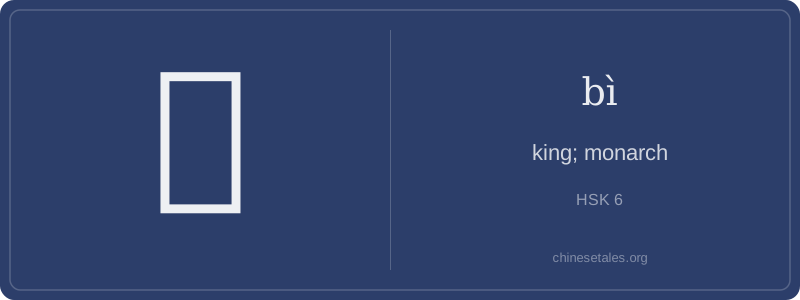
The earliest form of 辟 appears on Western Zhou bronze inscriptions as a complex composite: at the top, a stylized ‘person’ (人) holding a ceremonial axe (a variant of 斧), below which sits the radical 辛 — originally a chisel or branding tool symbolizing judicial authority and punishment. Over centuries, the person-and-axe merged into the upper component + 口 + 辛, simplifying into today’s 辟: 13 strokes where every line conveys control — the vertical stroke of authority, the enclosing ‘mouth’ (口) suggesting proclamation, and the sharp, angular 辛 beneath, like a judge’s gavel striking truth. It was never a picture of a throne or crown, but of *enactment*: the sovereign as active agent of cosmic order.
This action-oriented origin shaped its meaning: in the Book of Documents (《尚书》), ‘辟’ appears in ‘皇天无亲,惟德是辅;民心无常,惟惠之怀’ — where ‘辟’ refers to the ruler who must *open* virtue (辟德) to earn Heaven’s mandate. By the Han dynasty, it became a standard honorific title, especially in official documents addressing the emperor. Its visual link to 辛 (bitter, demanding) wasn’t accidental: Confucius wrote that ‘为政以德,譬如北辰,居其所而众星共之’ — the sovereign’s virtue must be as unyielding and precise as the tool in the character’s base.
At first glance, 辟 (bì) feels like a relic — it’s not the word you’d use for ‘king’ in modern Mandarin (that’s usually 王 or 皇帝); instead, it’s a literary, almost ceremonial term evoking the awe and distance of ancient sovereignty. Think less ‘monarch’ as political office, more ‘sovereign’ as cosmic authority — the kind that ‘opens up’ heaven and earth, establishes rites, and commands fate. In classical texts, 辟 is often used as a respectful third-person pronoun for rulers (like ‘His Majesty’), never self-referentially: ‘the ruler says’ becomes ‘辟曰’, never ‘我辟’. This humility-in-honor reflects deep-rooted Confucian hierarchy: power is legitimate only when exercised with ritual propriety (礼), not raw force.
Grammatically, 辟 appears mainly in fixed classical phrases or formal compounds — never standalone in speech. You’ll find it in passive constructions like ‘为…所辟’ (‘was appointed by the sovereign’) or in honorific titles like 太辟 (an archaic term for the supreme ruler). Learners often misread it as pì (e.g., confusing it with 辟邪 ‘to ward off evil’) — but here, bì is non-negotiable. Using pì in a classical context would sound like calling the emperor ‘to open’ — comically inappropriate!
Culturally, 辟 embodies the Chinese idea that true kingship isn’t about crowns or armies, but about *opening* — opening paths, opening virtue, opening harmony between heaven and humanity. That’s why its radical is 辛 (‘bitter, pungent, demanding’): sovereignty isn’t sweet; it’s exacting, disciplined, even painful. Modern learners miss this weight — they treat it as just another synonym for ‘king’, overlooking how its very shape and sound encode the moral gravity of rule.