迄
Character Story & Explanation
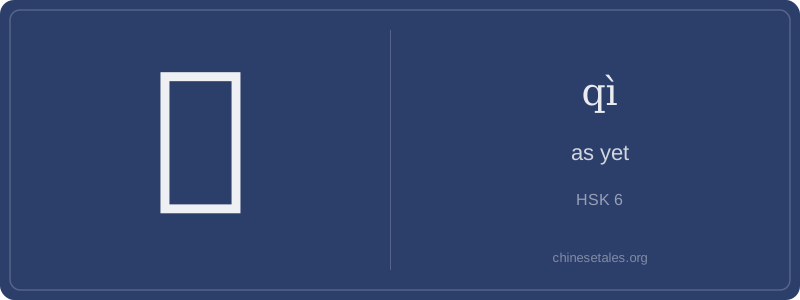
The earliest form of 迄 appears in bronze inscriptions as a compound: the left side was ‘辵’ (chuò), an ancient walking radical showing a person stepping forward (later simplified to 辶), and the right was ‘乞’ (qǐ), which originally depicted a person extending hands in supplication — not begging, but *reaching toward something just out of grasp*. Over centuries, 乞 streamlined into its modern shape, and the walking radical shifted below, forming today’s 迄: six strokes total — a compact visual metaphor for movement halted at a boundary.
This image of ‘reaching but not yet arriving’ became deeply embedded in classical usage. In the *Zuo Zhuan*, 迄 appears in phrases like ‘迄于今日’ (qì yú jīn rì), marking how long a state of affairs has persisted without resolution. The character never lost its sense of suspended motion — even in modern Mandarin, it evokes time stretching taut, like a bowstring pulled back but not yet released. Its elegance lies in restraint: no flourish, no finality — just the precise, quiet moment *before*.
Think of 迄 (qì) as Chinese’s elegant pause button — not a hard stop, but a gentle ‘up to now’ or ‘as yet’. It doesn’t mean ‘never’, and it doesn’t mean ‘already’; it lives in that suspended space between expectation and completion. You’ll almost never see it alone: it’s a grammatical glue word, always paired with 今 (jīn), 来 (lái), or 止 (zhǐ) — like 迄今 (qì jīn, ‘to this day’) or 迄今为止 (qì jīn wéi zhǐ, ‘up to now’). Its vibe is formal, literary, and slightly solemn — you’d use it in academic writing or news reports, not texting your friend about lunch.
Grammatically, 迄 is a preposition-like coverb that marks temporal boundaries — it anchors an action *up to* a point, never *beyond*. Learners often misplace it or overuse it trying to say ‘yet’ (which is usually 还没 yòu méi in spoken Chinese). For example, saying *‘Wǒ qì kàn le zhè běn shū’* is wrong — 迄 can’t take aspect particles like 了. Instead, it’s always part of fixed phrases: 迄今未解 (qì jīn wèi jiě, ‘remains unsolved to this day’).
Culturally, 迄 carries quiet authority — it’s the character historians use when declaring ‘no verified record exists *as yet*’, implying both humility before evidence and confidence in method. A common mistake? Confusing it with 启 (qǐ, ‘to initiate’) or 已 (yǐ, ‘already’) — their shapes and tones are close, but mixing them flips meaning entirely. Remember: 迄 is about the *unreached threshold*, not the starting line or the finish line.