迸
Character Story & Explanation
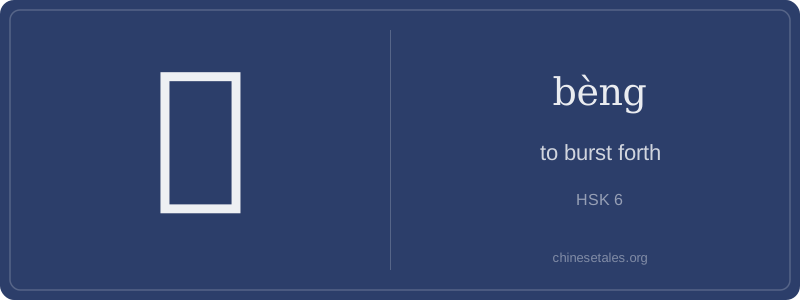
The earliest form of 迸 appears in Han dynasty seal script as a combination of 氵 (water) + 并 (bìng, ‘together; merge’) + 辵 (chuò, variant of 辶, ‘walking’). Visually, it imagined water gushing *in unison* along a path — like twin streams converging and bursting forward down a slope. Over centuries, 氵 simplified to three dots, 并 condensed into the top-left 井-like shape (two parallel strokes crossed by two horizontals), and 辵 evolved into today’s flowing 辶 radical — nine strokes total, each echoing motion and convergence.
This visual logic shaped its meaning: not just ‘burst,’ but ‘burst *forth together, along a path*.’ In the Shuōwén Jiězì (121 CE), it’s defined as ‘water leaping out,’ and by the Tang, poets like Li Bai used 迸 to describe stars迸射 across the night sky — capturing celestial energy moving *outward*. Its power lies in this duality: collective force (from 并) + directed motion (from 辶) = unstoppable emergence.
Think of 迸 (bèng) as Chinese’s version of a champagne cork exploding — not just ‘bursting,’ but bursting *outward with sudden, unstoppable energy*. It’s visceral, directional, and almost always implies force breaking containment: sparks迸出 from grinding metal, tears迸出 from suppressed grief, or laughter迸出 before you can stop it. Unlike generic ‘burst’ verbs like 爆 (bào), 迸 emphasizes the *trajectory* — outward, upward, forward — and often carries poetic or literary weight.
Grammatically, 迸 is almost always used intransitively with 出 (bèng chū) to complete the ‘burst forth’ meaning, or passively in descriptive phrases like 迸发 (bèngfā, ‘to erupt/spark’). You’ll rarely see it alone — it’s a sprinter, not a marathon runner. Learners often mistakenly use it like 爆 or 破, but 迸 never means ‘explode’ in the destructive sense (that’s 炸), nor does it imply shattering (that’s 碎). It’s about radiant, kinetic release — think fireworks, not bombs.
Culturally, 迸 thrives in classical poetry and modern political rhetoric alike: Mao wrote of revolutionary spirit 迸发, while Tang poets used it for dewdrops迸溅 off lotus leaves at dawn. A common pitfall? Using it for slow, emotional welling-up (use 涌 yǒng instead). Also, note its radical 辶 (‘walking’) — yes, even bursting has a path!