酌
Character Story & Explanation
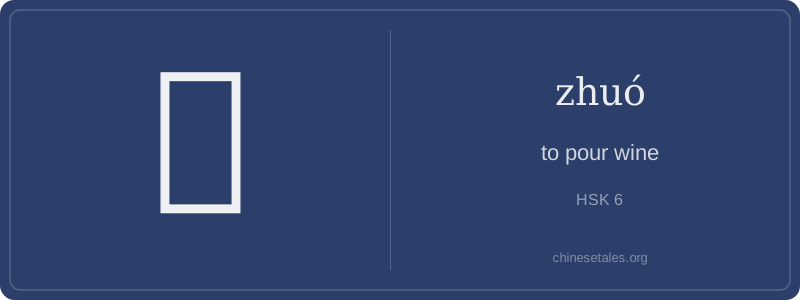
The earliest form of 酌 appears in bronze inscriptions as a combination of 酉 (a wine vessel, radical) and 勺 (sháo, a ladle — originally a pictograph of a curved spoon with a handle). The oracle bone version is lost, but by the Western Zhou period, it clearly showed a hand holding a ladle over a wine jar — a literal ‘ladling wine’. Over centuries, the ladle (勺) simplified: its dot became a horizontal stroke, its curve became the slanted hook and dot on the right, while 酉 retained its iconic ‘jar’ shape with ten strokes total — including the crucial ‘lid’ (the top horizontal) and ‘spout’ (the left vertical).
This visual logic anchored its meaning: pouring wasn’t casual — it required a tool (勺), a vessel (酉), and human agency. In the *Book of Songs*, 酌 appears in odes describing ritual banquets where elders poured wine for juniors — an act of hierarchy and harmony. By the Han dynasty, scholars extended the metaphor: just as one measures wine carefully, one must ‘pour over’ ideas — hence 酌 became synonymous with careful consideration. Its shape still whispers: *hand + ladle + jar = intentional action*.
At its heart, 酌 (zhuó) isn’t just ‘to pour wine’ — it’s the quiet ritual of mindful offering. In classical Chinese, it evokes the deliberate, respectful act of ladling wine from a vessel during ancestral rites or scholarly banquets: not glugging, not serving mechanically, but *measuring with care*. That nuance sticks: even today, 酌 carries a subtle weight of deliberation and appropriateness — think ‘weighing options’ or ‘considering carefully’, especially in formal or literary contexts.
Grammatically, 酌 is almost never used alone in modern speech; it appears primarily in compound verbs (e.g., 斟酌) or as a literary verb meaning ‘to pour’ (often in poetic or ceremonial descriptions). Learners mistakenly try to use it like 倒 (dǎo, ‘to pour’) in everyday sentences — but saying ‘我酌一杯酒’ sounds archaic or comically stiff. Instead, you’ll hear it in fixed expressions: ‘请酌情处理’ (qǐng zhuó qíng chǔ lǐ — ‘please handle this at your discretion’), where 酌 subtly implies ‘pouring judgment with measured wisdom’.
Culturally, 酌 reflects the Confucian ideal of *zhōng yōng* (the Mean): balance, restraint, and context-aware action. It’s not about the wine — it’s about the intention behind the pour. A common error is misreading it as ‘zhuō’ (like 捉) or confusing it with 酒 (jiǔ, ‘wine’) — but 酌 isn’t the drink, it’s the *act of offering it thoughtfully*. That distinction is everything: one character holds an entire philosophy of mindful engagement.