酗
Character Story & Explanation
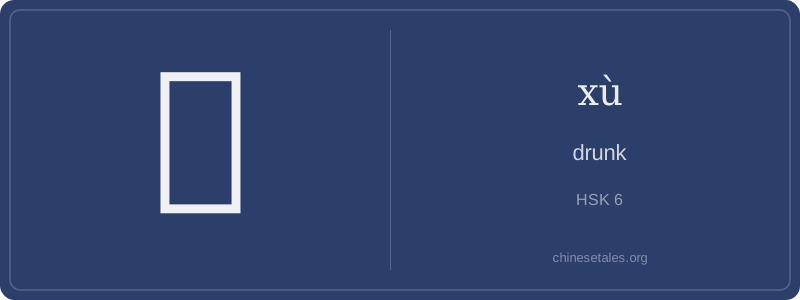
The character 酗 first appeared in seal script around 2,200 years ago. Its left side, 酉 (yǒu), is the 'wine vessel' radical — originally a pictograph of a tall, narrow bronze jar used in ancestral rites. The right side, 亢 (kàng), looks like two strokes rising sharply over a horizontal line — mimicking a person straining upward, head tilted back, neck taut. Together, they formed a vivid image: someone tilting their head back to gulp wine *too eagerly*, *too repeatedly* — not sipping, but guzzling. Over centuries, the lines smoothed into the modern 11-stroke form, but the visual tension remained: vessel + strained posture = loss of restraint.
This physicality shaped its meaning from the start. In the Han Feizi, 酗 described rulers who 'drank until their heads throbbed and their judgments collapsed'. By the Tang dynasty, poets like Du Fu used it to condemn officials whose drunkenness led to corruption. Crucially, 酗 never meant 'tipsy' or 'celebratory' — its etymology locked it to excess and consequence. Even today, the character’s shape whispers the same warning: when the vessel meets the strained neck, balance is already lost.
At first glance, 酗 (xù) means 'to get drunk' — but it’s never neutral. In Chinese, this character carries a sharp moral edge: it implies habitual, reckless, self-destructive drinking — the kind that ruins health, families, or careers. You’ll almost never see it in cheerful contexts like 'let’s have a drink!' Instead, it appears in warnings, news headlines about alcoholism, or official documents condemning '酗酒驾车' (drunk driving). It’s not just 'drunk' — it’s 'drunk *and out of control*.'
Grammatically, 酗 is almost always used as a verb prefixing another verb or noun: 酗酒 (xù jiǔ, 'to binge-drink'), 酗赌 (xù dǔ, 'to gamble while intoxicated'), or 酗殴 (xù ōu, 'to drunkenly assault'). It rarely stands alone — unlike English 'drunk', which can be an adjective ('He’s drunk'), 酗 is strictly verbal and action-oriented. Learners often mistakenly use it where they need the adjective 醉 (zuì); saying '他酗了' is ungrammatical — you’d say '他醉了'.
Culturally, 酗 reflects China’s long-standing ambivalence toward alcohol: revered in ritual and poetry (think Li Bai), yet fiercely condemned when it breaches social harmony. The character itself is a linguistic red flag — its presence signals disapproval, not description. That’s why even HSK 6 learners miss its tone: it’s not vocabulary, it’s *ethics in script*. Confusing it with neutral terms like 喝 (hē, 'to drink') risks sounding alarmingly judgmental — or dangerously naive.