锈
Character Story & Explanation
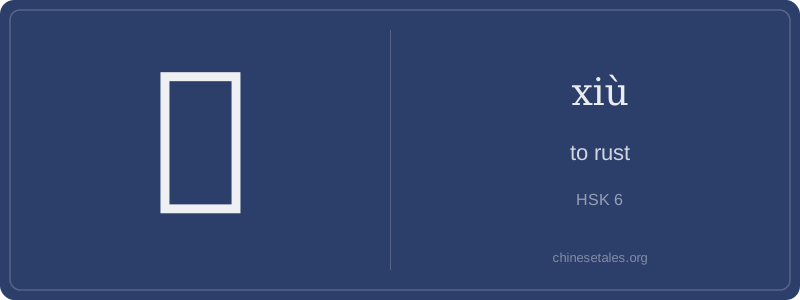
The earliest form of 锈 appears not in oracle bones (too late for rust imagery), but in bronze inscriptions and early seal script, where it evolved from two components: the metal radical 钅 (originally 金, 'metal') on the left, and 又 (yòu, 'again' or 'hand') plus 宿 (sù, 'to lodge' or 'overnight') on the right — though in modern form, the right side simplifies to 秀 (xiù, 'excellent; flourishing'). Wait — that seems contradictory! In fact, 秀 was borrowed for its sound (xiù), not meaning — a classic phonetic loan. The original small-seal form showed 钅 + 宿, with 宿’s top part (宀 + 佰) gradually stylized into 秀’s elegant strokes: the 'grain' (禾) above 'leg' (乃) became a visual echo of oxidation spreading like delicate, unwanted blossoms across metal.
This sound-based borrowing is why 锈 feels so counterintuitive: its right side means 'beauty' or 'excellence', yet the whole character signifies corrosion. Classical texts rarely mention rust literally — metal objects were precious and well-maintained — but by the Ming and Qing dynasties, rust appears in practical manuals describing sword care and shipbuilding. The irony stuck: a character built from the word for 'flourishing' now denotes decay — a linguistic fossil of how language repurposes beauty to name blight.
Think of 锈 (xiù) as Chinese’s answer to the 'rust monster' — not a creature from folklore, but a quiet, insidious force that eats away at metal like time gnawing at old bridges or forgotten bicycles left in the rain. In English, 'to rust' is purely physical, but in Chinese, 锈 carries a subtle emotional weight: it implies neglect, decay, and the passage of time — almost poetic in its melancholy. You’ll rarely hear it used transitively ('I rusted the gate'); instead, it’s usually intransitive ('the gate rusted') or passive ('the gate became rusty'), often with 起来, 掉, or 了 to mark change or result.
Grammatically, 锈 behaves like a verb meaning 'to oxidize', but it can also function as a noun ('rust') — as in 铁锈 (tiě xiù, 'iron rust'). Learners often mistakenly use it like a transitive verb (e.g., *他锈了门 — wrong), when the correct form is 门锈了 (the door rusted) or 门生锈了 (the door developed rust). Note: 生锈 (shēng xiù) is the most common verbal phrase — literally 'to generate rust' — and is always intransitive.
Culturally, rust isn’t just chemistry — it’s a metaphor for obsolescence and fading relevance. A tech company might warn that 'skills rust without practice' (技能不练就会生锈), borrowing the character’s visceral imagery to evoke irreversible decline. Western learners often overgeneralize it to non-metal contexts (e.g., *wood rusts), but 锈 applies only to metals — unlike 腐烂 (fǔlàn, 'rot'), which covers organic decay. And yes, even stainless steel can ‘rust’ in Chinese — if it stains or corrodes, it’s 锈, regardless of metallurgical precision.