陡
Character Story & Explanation
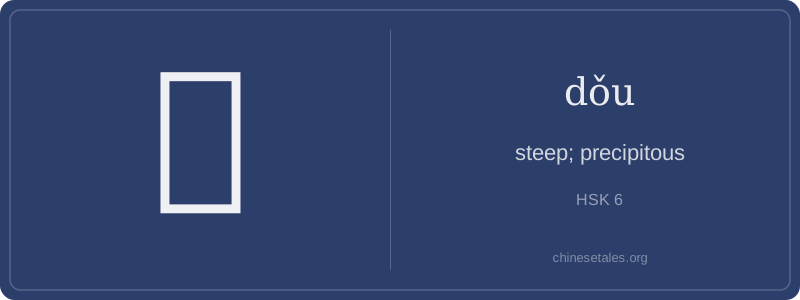
The earliest form of 陡 appears in seal script (c. 3rd century BCE), where it combines the ‘hill/mountain’ radical 阝 (originally 阜, fù — depicting a series of rising terraces or earthen mounds) with the phonetic component 走 (zǒu, ‘to walk’), later simplified to 巟 (huāng, now obsolete as a standalone). But here’s the twist: in early bronze inscriptions, the right side wasn’t 走 — it was a stylized ‘person climbing vertically’, with arms outstretched against a near-vertical line. Over centuries, this evolved into the modern 又 (yòu) + 一 (yī) shape we see today — visually echoing a climber’s two arms gripping a sheer face, with the horizontal stroke representing the narrow ledge they cling to.
This visual logic cemented its meaning: not just ‘uphill’, but ‘so uphill you must grip and haul’. By the Tang dynasty, poets like Du Fu used 陡 to evoke both physical peril and emotional vertigo — e.g., in ‘山势陡绝’ (shān shì dǒu jué), describing cliffs so sheer they ‘cut off’ ascent. The character’s enduring power lies in how its strokes *perform* steepness: the left radical (阝) anchors like bedrock; the right side (厶+一+丨) looks like a climber’s silhouette frozen mid-ascent — no gentle curve, only angles and tension.
At its core, 陡 (dǒu) isn’t just ‘steep’ — it’s the visceral lurch in your stomach when you peer over a cliff edge or hike up a trail that turns vertical without warning. It carries tension, suddenness, and physical resistance: think sheer rock faces, abrupt policy shifts, or an unexpected surge in prices. Unlike generic adjectives like 高 (gāo, ‘high’) or 深 (shēn, ‘deep’), 陡 always implies a sharp *gradient* — not height or depth alone, but how abruptly terrain, emotion, or change rises or falls.
Grammatically, 陡 functions primarily as an adjective before nouns (e.g., 陡坡 dǒu pō, ‘steep slope’) or as a predicate after 是 or 很 (e.g., 这段路很陡 — zhè duàn lù hěn dǒu, ‘This stretch of road is steep’). Crucially, it’s rarely used in isolation — you won’t say ‘It’s 陡!’ You’ll say ‘It’s *steep*’ (很陡) or pair it with a noun. Learners often mistakenly use it as a verb (‘to steepen’) — but Chinese uses 陡峭起来 (dǒu qiào qǐ lái) or 加陡 (jiā dǒu) for that. Also, note: 陡 never means ‘abrupt’ on its own — for sudden *timing*, use 突然 (tū rán); 陡 modifies *degree of incline* or *rate of change*.
Culturally, 陡 appears frequently in landscape poetry and modern economic reporting — where ‘a 陡 rise in inflation’ subtly evokes geological inevitability, not mere speed. A classic learner trap? Confusing it with 坡 (pō, ‘slope’) — which is neutral and gradual — or misplacing tones (dǒu ≠ dōu or dòu). And remember: while English says ‘steep hill’, Chinese prefers 陡坡 — the character itself *is* the steepness, not just a descriptor.