陈
Character Story & Explanation
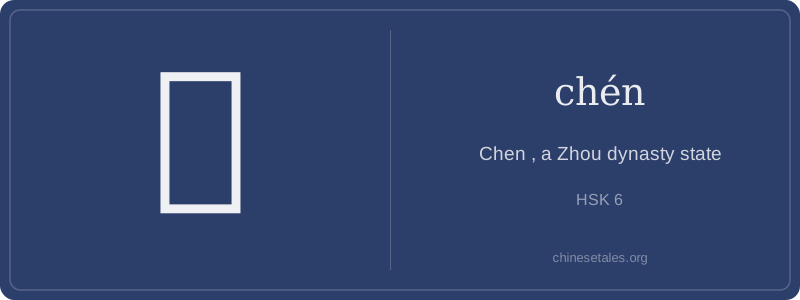
The earliest form of 陈 appears on Western Zhou bronze inscriptions as a compound pictograph: a city wall (阝, later standardized as the right-side radical) paired with 东 — which itself began as a pictograph of a ‘wooden beam with supporting posts’ (a symbol of structural integrity and direction). In oracle bone script, the ‘east’ element may have even resembled two crossed poles marking a ritual site. Over centuries, the left side simplified from complex early forms of 东 into today’s streamlined 东, while the right-side wall radical solidified into 阝 — always grounding the character in the idea of a defined, authoritative space.
This visual logic shaped its meaning: 陈 originally referred to the ancient State of Chen (陈国), a vassal state of the Zhou dynasty located in modern-day Henan — a real geopolitical entity marked on maps and fortified walls. From there, it extended to ‘laying out troops before battle’ (as in classical military texts like the Zuo Zhuan), then abstracted to ‘presenting facts’ or ‘displaying objects’. Confucius himself was said to have ‘stated his principles clearly’ (陈其志) — showing how early this verb sense carried moral weight. The character’s enduring shape — wall + east — quietly encodes an ancient worldview: truth and order are established when things are placed deliberately, facing the rising sun, within secure boundaries.
At its heart, 陈 (chén) is a quiet powerhouse — not flashy like 战 (war) or warm like 爱 (love), but deeply woven into China’s social and historical fabric. As a proper noun, it’s one of the most common surnames in China (and globally among Chinese diaspora), evoking ancestral roots, clan identity, and continuity across dynasties. But as a verb, 陈 carries elegant weight: it means ‘to display’, ‘to lay out’, or ‘to state formally’ — think of a scholar presenting evidence before a magistrate, or a museum curator arranging artifacts with reverence. It’s never casual; it implies order, intention, and respect for structure.
Grammatically, 陈 often appears in literary or formal registers — you’ll rarely hear it in daily chit-chat (‘I’m telling you…’ is usually 我跟你说, not 我陈…). Instead, it shines in written contexts: 陈述 (chénshù, ‘to state/declare’) is standard in legal documents and academic writing; 陈列 (chénliè, ‘to display’) is the go-to for museums and retail. Learners mistakenly use 陈 as a synonym for 说 (say) — but that’s like using ‘articulate’ instead of ‘talk’. The tone matters: 陈 feels deliberate, almost ceremonial.
Culturally, 陈 reveals how Chinese values link language to posture — literally. Its radical 阝 (right ear radical, originally ‘city wall’) anchors it in place, while the phonetic component 东 (dōng, ‘east’) hints at orientation and order. Many learners misread it as ‘old’ because of homophones like 陈旧 (chénjiù, ‘outdated’), but that’s a semantic extension — not the core meaning. Remember: 陈 isn’t about age; it’s about arrangement, presentation, and presence in space and time.