隐
Character Story & Explanation
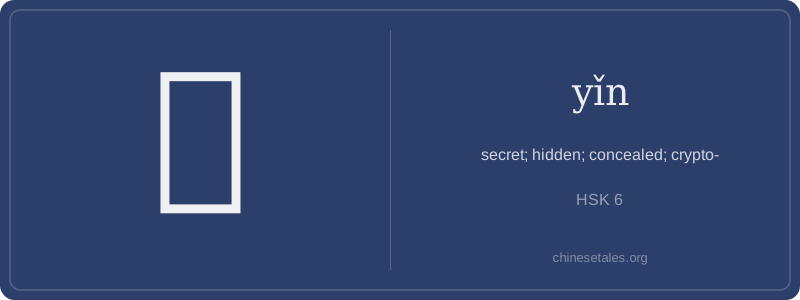
The earliest form of 隐 appears on Warring States bamboo slips — not as a pictograph, but as a phonosemantic compound already. Its left side, 丨 (gǔn) + 一 + 丨 (a simplified version of 印 yìn, meaning ‘seal’ or ‘stamp’), was the phonetic hint, while the right side, 阝 (the ‘hill/land’ radical, originally 阜 fù), signaled terrain — specifically, hills that provide natural cover. Over centuries, the left morphed into 纟 (sī, ‘silk’) + 殷 (yīn, a phonetic base), then further stylized into today’s 纟 + 㥯 (a variant), finally settling as the elegant 11-stroke 隐 we write now — every stroke echoing layers of shelter and discretion.
This visual logic mirrors its semantic journey: from concrete ‘hiding behind hills’ (as in the Classic of Poetry: ‘隐于南山’ — ‘hiding in the southern mountains’) to abstract ‘concealing truth’ (in Legalist texts) and later ‘withdrawing from public life’ (a Confucian-Daoist virtue). The character’s enduring power lies in how its shape — a delicate balance of flowing silk-like strokes (纟) anchoring a grounded hill (阝) — embodies both subtlety and resolve: concealment as moral posture, not evasion.
At its heart, 隐 (yǐn) isn’t just ‘hidden’ — it’s the quiet hum of something deliberately withdrawn: a secret kept out of duty, a scholar retreating to mountains, or data encrypted beyond reach. It carries weight and intention — unlike passive ‘covered’ characters like 盖 (gài), 隐 implies agency and choice. Think of it as the Chinese linguistic equivalent of lowering your voice, closing a door, or turning off your location.
Grammatically, 隐 is most often a verb (‘to conceal’) or an adjective (‘hidden’), but it also appears in elegant compound nouns and formal adjectives. As a verb, it takes objects directly: 他隐去了姓名 (tā yǐn qù le xìngmíng — ‘He concealed his name’). As an adjective, it usually modifies nouns with 的: 隐形眼镜 (yǐnxíng yǎnjìng — ‘contact lenses’, literally ‘invisible eyeglasses’). Learners often mistakenly use it where English says ‘private’ — but that’s 私 (sī); 隐 suggests active removal from view, not just personal ownership.
Culturally, 隐 resonates deeply with Daoist and reclusive ideals — think of Tao Yuanming quitting office to ‘hide’ in pastoral life (归隐 guīyǐn). Mispronouncing it as yìn (a rare literary reading, e.g., in 隐忍 yìn rěn — ‘to endure in silence’) trips up even advanced learners; yǐn is correct for >95% of modern usage. Also beware: 隐 never means ‘to disappear’ magically — for that, use 消失 (xiāoshī). It’s about *intentional* concealment, not vanishing.