隶
Character Story & Explanation
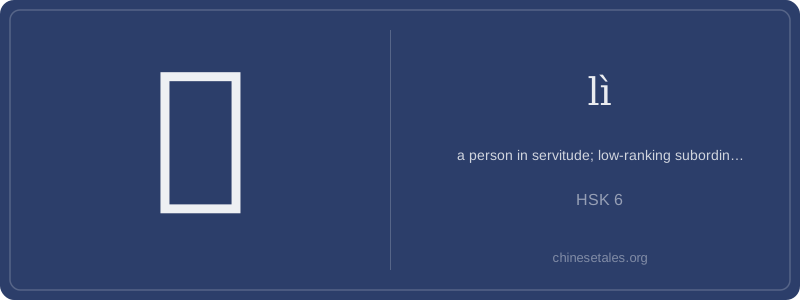
The earliest form of 隶 appears in Warring States bamboo slips — not as a pictograph, but as a highly stylized, compact character evolving from the older character 徒 (tú, ‘convict laborer’). Its top part resembles a simplified ‘radical for servant’ (隶 itself became its own radical), while the lower half preserves traces of 肉 (ròu, ‘flesh’) or 丨 (gǔn, ‘vertical stroke’ symbolizing binding), suggesting bodily constraint. Over centuries, the character condensed: the upper component hardened into two parallel horizontal strokes and a dot (⿱一丶一), evoking shackles or ink-brush strokes made under supervision; the lower part solidified into the distinctive ‘crouching’ shape resembling a person kneeling with arms folded — a posture of submission and service.
This visual evolution mirrors its semantic journey: from concrete ‘convict assigned to clerical work’ (Qin dynasty legal texts) to abstract ‘formal subordination’ (Han dynasty administrative documents). By the Eastern Han, 隶 had become inseparable from clerical script (隶书) — the first standardized cursive-adjacent hand used by government scribes, literally ‘the script of the clerks’. The character thus embodies a paradox: a mark of low status that birthed China’s most influential calligraphic style. As Ban Gu wrote in the Hanshu, ‘吏隶执笔,字乃成体’ (‘Scribes and clerks held the brush — only then did the script take shape’), cementing 隶 as both social category and cultural catalyst.
Think of 隶 (lì) as Chinese bureaucracy’s ‘junior associate’ — not quite a slave, not quite a colleague, but permanently stuck in the middle tier of hierarchy, like a medieval scribe copying royal decrees or a modern-day intern who files paperwork but can’t sign anything. Its core meaning isn’t just ‘servant’ but ‘bound subordinate’: someone whose status is legally and socially fixed, often through state assignment — less ‘employee’ and more ‘designated functionary’. That’s why it rarely stands alone in speech: you’ll almost never hear someone say ‘他是隶’; instead, it appears in formal compounds like 隶属 (lìshǔ, ‘to be subordinate to’) or 隶书 (lìshū, ‘clerical script’ — named because it was standardized by low-ranking clerks).
Grammatically, 隶 is almost exclusively bound — it doesn’t act as a standalone noun or verb in modern usage. It’s the quiet engine inside verbs (隶属), nouns (隶役), and historical terms (徒隶). Learners often misread it as ‘li’ without tone (e.g., confusing it with 离 lì ‘to depart’) or overgeneralize its meaning — assuming any ‘subordinate’ context fits, when in fact it carries strong connotations of *institutional subordination*, not just personal deference. You wouldn’t use 隶 for ‘my assistant at work’ unless evoking rigid hierarchy — it’s too heavy, too historical.
Culturally, 隶 evokes the Qin-Han legalist system, where people were classified into rigid strata: free citizens, convicts, and 隶 — those sentenced to forced clerical or manual labor, often for generations. That legacy lingers: calling something 隶属 feels weightier and more systemic than saying it’s ‘under’ or ‘part of’ — it implies structural dependency, even loss of autonomy. Misusing it risks sounding archaic, bureaucratic, or unintentionally dehumanizing — a nuance English learners rarely anticipate.