教
Character Story & Explanation
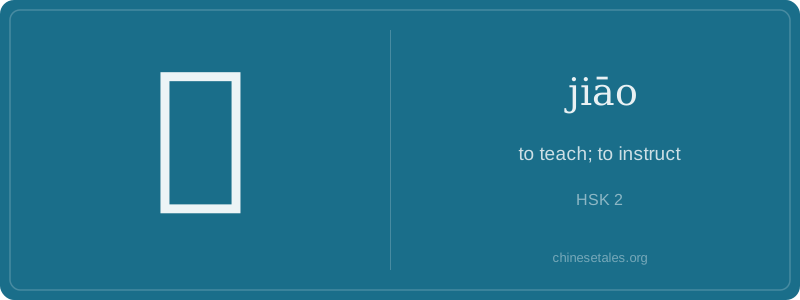
The earliest form of 教, found on Shang dynasty oracle bones, was a complex pictograph: at the top, a child’s head (a simplified , later evolving into 孝); below, two hands holding a rod or switch (攴, later standardized as 攵); and on the right, a mouth (口), symbolizing spoken instruction. It literally depicted ‘guiding a child with words and gentle correction’ — not punishment, but corrective, loving guidance. Over centuries, the child-head morphed into 肖 (xiāo), then simplified to 孝 and finally to the modern 肖-like upper component (丿 + 一 + 口 + 子), while the hand-and-rod became the radical 攵 (pū), meaning ‘to tap’ or ‘to prompt’.
This visual logic stayed powerfully intact: teaching was never abstract theory, but embodied, interactive, and ethically grounded action. By the Han dynasty, 教 appeared in texts like the Book of Rites (Lǐjì), defining education as ‘nurturing virtue through ritual and speech’. Even today, the character’s structure whispers its ancient truth: knowledge flows only when voice (口), guidance (攵), and the learner (子) are all present — no shortcuts, no passive absorption.
At its heart, 教 (jiāo) isn’t just ‘to teach’ — it’s about *transmission with care*. In Chinese thought, teaching isn’t passive lecturing; it’s an active, respectful passing down of knowledge, values, or skill — like handing a lit torch to someone else. That’s why 教 almost always implies intention, effort, and responsibility: you 教 someone *how* to do something, not just *that* something is true.
Grammatically, 教 is wonderfully flexible at HSK 2 level: it takes two objects (‘teach [person] [thing]’) — e.g., ‘tā jiāo wǒ hànyǔ’ (She teaches me Chinese). Unlike English, you *must* include the learner (the indirect object); saying ‘she teaches Chinese’ without specifying *whom* sounds incomplete or even arrogant in Chinese. Also watch the tone: jiāo (first tone) = to teach; jiào (fourth tone) appears in nouns like ‘jiàoshī’ (teacher) or ‘jiàoyù’ (education) — but never as a verb meaning ‘to teach’.
Culturally, 教 carries quiet weight: Confucius began the Analects with 學而時習之,不亦說乎?(‘Is it not a joy to learn and practice regularly?’), and the very word for ‘school’ is 學校 (xuéxiào), where 學 (to learn) comes first — reflecting the ideal that teaching only matters when learning happens. Learners often mistakenly use 教 where they mean ‘explain’ (jiěshì) or ‘show’ (gěi kàn), missing the relational, mentor-like commitment this character embodies.