旁
Character Story & Explanation
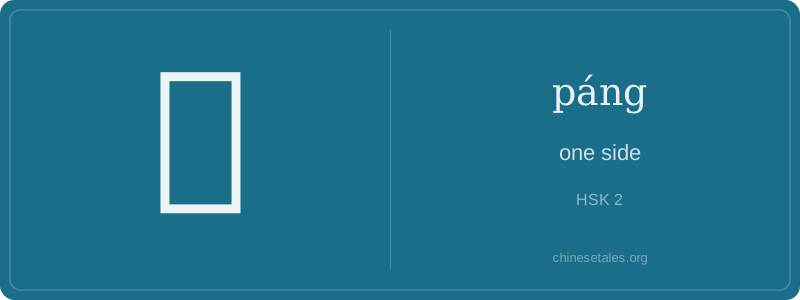
The earliest form of 旁 appears in bronze inscriptions as a stylized pictograph: a square-like enclosure (the ancestor of 方, its modern radical) with two parallel lines slanting outward from its right side — evoking ‘something extending beside’ or ‘flanking’. Over centuries, those lines evolved into the top-right strokes (丶 and 一), while the bottom right became the distinctive 丿 + 一 combination. Crucially, the radical 方 wasn’t just decorative — it anchored the idea of orientation, as 方 originally meant ‘direction’ or ‘region’. So 旁 wasn’t drawn as ‘a side’, but as ‘direction-adjacent’ — a conceptual mapping still alive today.
This directional adjacency became deeply embedded in classical usage. In the Book of Rites, we find ‘旁行而不流’ — describing ritual movement that proceeds ‘beside (not through)’ sacred spaces, honoring boundaries without crossing them. The character’s visual asymmetry — balanced left (方) yet leaning right (the slanted strokes) — mirrors its semantic tension: centeredness with openness to what lies adjacent. Even today, when Chinese speakers say 身旁 (shēn páng, ‘beside oneself’), they’re invoking that ancient spatial ethics — proximity with respect, presence without possession.
At its heart, 旁 (páng) isn’t just ‘side’ — it’s the Chinese way of orienting yourself *relationally*. Unlike English, which often treats ‘side’ as a static location (‘the left side of the table’), 旁 carries gentle implication of proximity *without inclusion*: something is near, adjacent, or peripheral — but not part of the core. Think of it as the linguistic equivalent of standing respectfully just outside a circle of elders — close enough to listen, far enough to honor boundaries. That subtle social awareness is baked right in.
Grammatically, 旁 is almost always used postpositionally, glued to nouns with 的 or directly after place words: 桌子旁 (zhuōzi páng, ‘beside the table’), 学校旁 (xuéxiào páng, ‘near the school’). It never stands alone as a noun — you’d never say ‘I’m at the旁’. Learners often mistakenly treat it like English ‘side’ and try to use it adjectivally (e.g., *旁门* as ‘side door’) — but that’s actually a fixed compound; standalone 旁 doesn’t mean ‘side’ as a noun, only ‘beside/near’ as a relational marker.
Culturally, 旁 reflects the Confucian value of appropriate distance — not too close (intrusive), not too far (disengaged). Notice how 旁 appears in phrases like 旁观者 (pángguānzhě, ‘onlooker’): literally ‘one who stands beside’, observing without intervening. A classic learner mistake? Confusing it with 边 (biān), which means ‘edge’ or ‘border’ and implies a sharper, more defined boundary — whereas 旁 feels softer, more spatially forgiving, like the quiet space beside a teacup rather than the rim itself.